
Best Stain for Wood Fence: Top Picks for Lasting Color and Protection
Need your fence stained in Westminster, CO? See our fence staining service in Westminster or our deck staining service, then request a free estimate or call (720) 263-7210.
Picking the perfect finish for a wood fence in Colorado really is about mixing great appearance with solid, enduring protection. Having done fence work all along the Front Range for many years, we have observed that for the majority of people, an oil-based, semi-transparent stain of very good quality almost always is the top option. This type of stain not only goes deep into the wood which is very helpful for protecting it from sunlight but also, it allows the wood’s natural pattern to be visible and it is one of the best in a climate like ours.
Choosing The Right Fence Stain For Colorado Weather
A wood fence is a big investment, and here in Colorado, it takes a beating. We’ve got intense high-altitude sun, heavy snow, and wild temperature swings that can wreck a fence in just a few seasons. Picking the right stain isn’t just about color; it’s the most important thing you can do to protect your investment from turning gray, cracking, and eventually rotting away.
This isn’t just a local trend, either. Stained wood fencing is by far the most preferred option worldwide with a staggering 59.1% market share expected in 2024. It simply reflects the immense appreciation of a protective layer with beautifying qualities by the natural wood among homeowners around the globe.
Your Top Priority Determines The Best Stain
What do you want your fence to do for you? Answering that question is the first step. Are you trying to show off the beautiful grain of brand-new cedar? Or maybe you need to hide some blemishes on an older fence? Perhaps you just want the absolute longest time before you have to think about it again.
Each of these goals points to a different type of stain. For example, a transparent stain is perfect for highlighting flawless wood, but it won’t offer the same level of protection as a solid stain, which is the king of durability. If you’re thinking about your home’s overall curb appeal, our guide on choosing an exterior paint color can help put the fence into the bigger picture.
According to a professional painting company nearby, this decision tree gives you a great visual for how your priorities lead to the right product.
Clearly, if the key to you is always preserving that natural wood appearance then you’ll probably want to go with transparent stains. If you’re focused on highest level of protection and longest life, then solid stains will be your choice. Semi-transparent stains are kind of a middle ground ones, a great compromise.
To make things even easier, we’ve put together a quick cheat sheet that connects common goals with the best stain type for our unique Colorado challenges.
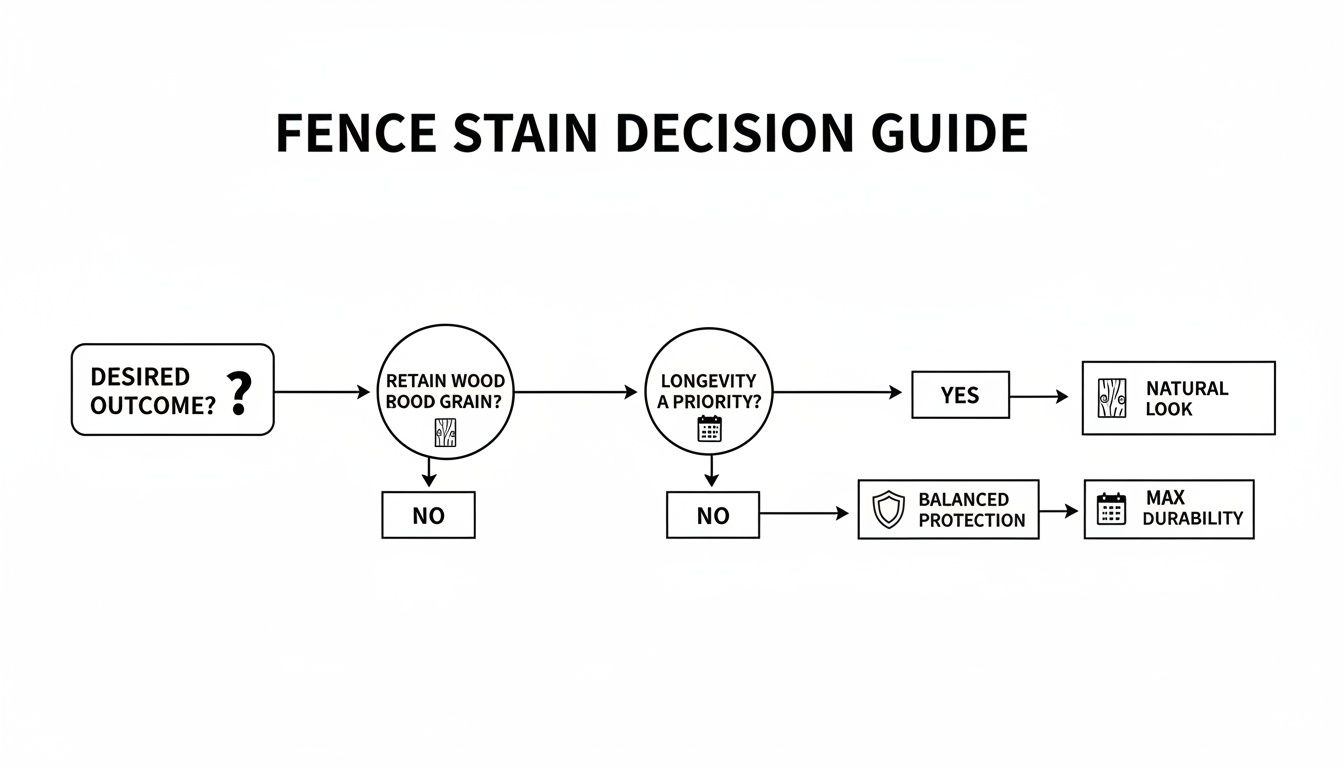
As you can see, if keeping that natural wood look is everything, you’ll lean toward transparent stains. If you’re all about maximum protection and longevity, solid stains are your best bet. The semi-transparent options live right in the middle, offering a great compromise.
To make things even easier, I’ve put together a quick cheat sheet that connects common goals with the best stain type for our unique Colorado challenges.
Quick Guide to Choosing Your Colorado Fence Stain
|
Your Main Priority |
Recommended Stain Base |
Recommended Opacity |
Average Lifespan in Colorado |
|
Showcasing Natural Wood Grain |
Oil-Based |
Transparent |
1–2 Years |
|
Balanced Look & Protection |
Oil or Water-Based |
Semi-Transparent |
2–4 Years |
|
Hiding Imperfections |
Water-Based |
Semi-Solid |
3–5 Years |
|
Maximum Durability & UV Block |
Water-Based |
Solid Color |
5–7+ Years |
The table you see here ought to provide a very good starting platform for you. Remember, that “average lifespan” is very much dependent on good prepping and the exact exposure your particular fence receives; for example, a south-facing fence will always require work more often than a shaded fence.
Oil-Based vs. Water-Based Stains: Which Is Right for Your Fence?
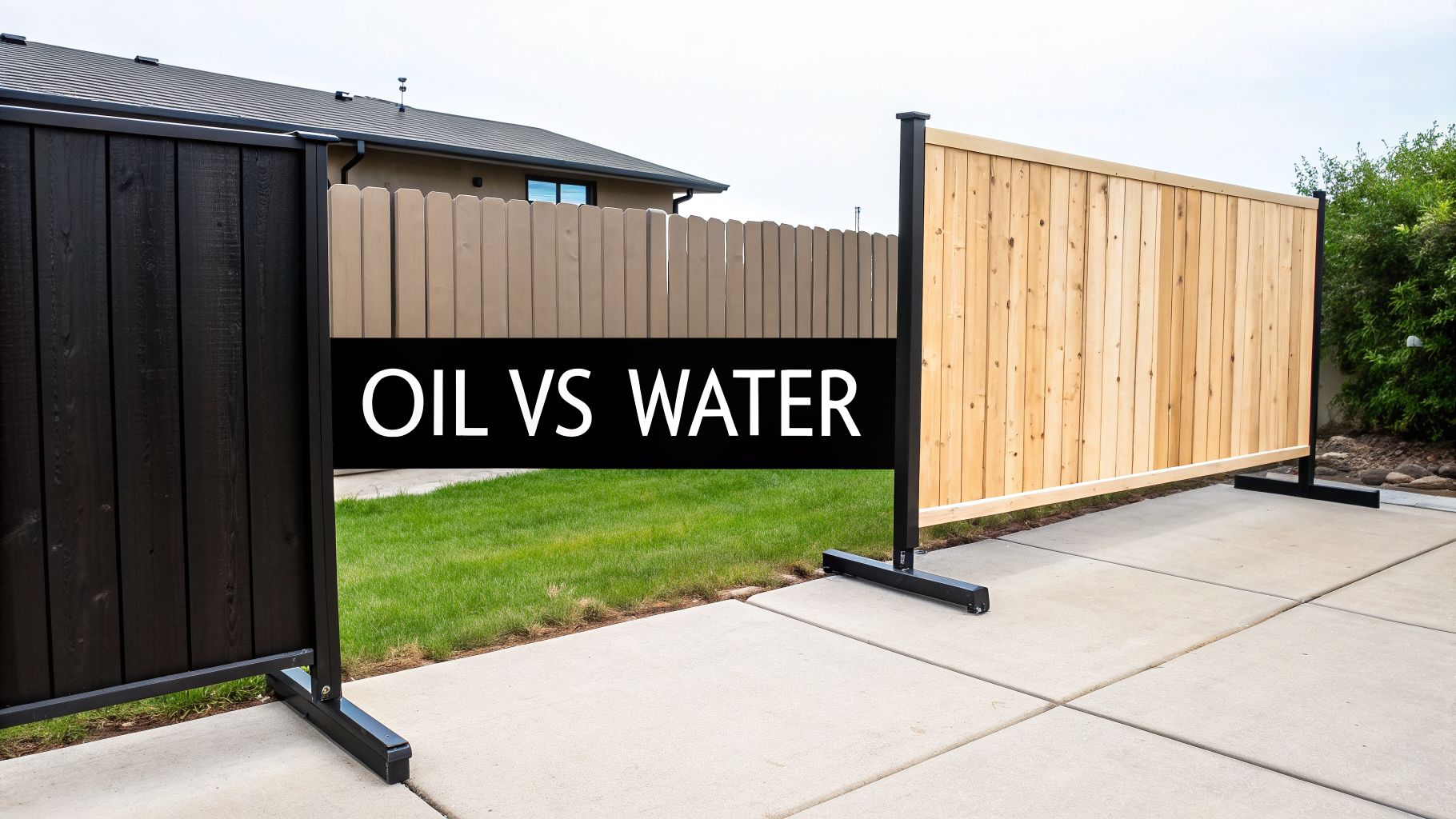
The first big decision that you have to decide on is whether to go for oil-based or water-based stain. It’s not just a minor thing; picking the right one is like setting the foundation of look and strength of your fence that will last hamper years, particularly in Colorado.
Think of it this way: oil-based stains are like a deep conditioning treatment that soaks into the wood, while water-based stains act more like a durable, flexible shell that sits on top.
The Deep Penetration of Oil-Based Stains
Oil-based stains are the traditional choice for a reason. They use natural oils, like linseed oil, that soak deeply into the wood fibers, essentially feeding the wood from the inside out. This creates incredible water repellency.
This strong saturation level is highly beneficial even for very dense woods such as cedar or for the old, thirsty fences which have been dried up by sun. By penetrating the wood’s pores, oil-based products form not only a strong but also a very effective barrier against moisture, thus being an essential weapon against rot and mildew which often appear in spring and summer after rains. The continuing existence of their market is evident: oil-based wood stains continue to generate USD 628.5 million in sales in the U.S., representing 26.1% of the total wood stain market.
Although they come with some issues, oil-based stains contain higher levels of volatile organic compounds (VOCs), which means that the fumes are stronger and the cleanup takes longer because you will need mineral spirits. Also, they tend to fade more quickly under the intense UV rays we have here and if they are not taken care of properly, in damp and shady areas they may even become a source of mildew growth.
The Flexible Protection of Water-Based Stains
Water-based stains have improved dramatically over the years. Modern acrylic formulas offer some serious durability. Instead of penetrating deeply, these stains form a protective film on the wood’s surface.
A few other reasons they have a competitive edge: This film is breathable that is a very important feature. It allows moisture vapor from inside the wood to escape, so it doesn’t peel or blister like other finishings. However, their main feature for a high-altitude climate such as Colorado is their wonderful color retention. UV breakdown resistance of the acrylic binders is much higher than that of the polymer binders, and as a result, the color remains true for a long time.
The real trade-off is penetration versus flexibility. Oil-based stains sink in deep for superior water repellency, while water-based stains form a flexible, UV-resistant coating that’s a champion at holding color.
That surface film is also more elastic. Because your fence wood will be constantly expanding and contracting with the wild temperature changes throughout the day in Colorado, a water-based stain will most likely move alongside the wood, thus greatly lowering the chances of cracking. Besides, they are low-VOC, have hardly any odor and you can simply clean them up with soap and water. If you want to go deeper, you can read our guide on oil-based vs. water-based stains where you will find the pros and cons weighed.
Making the Right Choice for Your Colorado Fence
So, what’s the verdict for our climate? Honestly, it depends entirely on your fence and your priorities.
Go with an Oil-Based Stain if:
- You have a new cedar or redwood fence and want to enhance its natural beauty.
- Your biggest enemy is moisture, and you need maximum water repellency.
- You’re aiming for that classic, rich, lustrous finish that only oils can provide.
Go with a Water-Based Stain if:
- Your fence is blasted by intense, direct sun. Its UV protection is superior.
- You’re re-staining an older, imperfect fence and need better, more uniform coverage.
- You value easy cleanup and low odor, a huge plus for any DIYer.
Basically, there is nothing much that a high-quality product from either category can’t do if you have done the prep work thoroughly. The ideal one should match your specific type of wood, the amount of sun exposure, and how much you are willing to do the maintenance in the future.
Understanding Stain Opacity: From Transparent to Solid
Picking a fence stain can be compared to selecting a pair of sunglasses. Will you go for a light shade that subtly enhances ground features or do you want completely dark shades that will block even the harsh sunlight of Colorado? The “opacity” of your stain is the same here; it’s only a question of how much of the wood grain you want to be visible versus how much of the color acts as a protecting layer.
That pigment is the key. It’s what provides the color, but more importantly, it’s your fence’s first line of defense against our harsh UV rays. The more pigment a stain has, the better it protects the wood from sunburn, which causes that faded, gray look and eventual decay. The “best” stain isn’t one-size-fits-all; it’s about finding the right balance of looks and protection for your specific fence and its condition.
Let’s walk through the four main categories, from barely-there protection to a full-on shield.
Transparent Stains
A transparent stain is for the purists. It’s designed to celebrate the wood’s natural character, not cover it up. With just a tiny bit of pigment, it acts more like a water-repellent sealer with a hint of tone, letting 100% of the wood grain and texture shine.
This is the go-to for gorgeous new cedar or redwood where you want to show off every knot and detail. But that beautiful clarity has a trade-off. Because there’s so little pigment, transparent stains offer minimal UV protection, meaning you’ll be out there reapplying it every 1-2 years under the Colorado sun.
Semi-Transparent Stains
This is the crowd-pleaser, and for good reason. Semi-transparent stains hit that sweet spot between protecting the wood and showing it off. You get a rich layer of color and a solid dose of UV blockers, but it’s still sheer enough to let the natural wood grain come through.
It’s our most requested finish for a reason, it works on almost any fence, new or a few years old. It makes the wood look its best and comes in a huge range of colors. You can expect to get 2-4 years of performance in our climate before it’s time for a maintenance coat. If you want some ideas, our guide to deck stain color options has plenty of inspiration that works just as well for fences.
The decision really boils down to this: Are you trying to highlight perfect, new wood, or are you trying to protect and unify an aging surface? Your answer points you directly to the right amount of pigment.
Semi-Solid Stains
Moving up the ladder, semi-solid stains start to offer some serious coverage. They pack a lot more pigment, hiding most of the grain but still letting the wood’s texture, those bumps and grooves, show through. It’s the perfect middle ground between a classic stain and a painted look.
We often recommend a semi-solid when a fence has seen a few seasons. It’s fantastic for covering up imperfections, uneven coloring, or the remnants of an old, faded stain. That higher pigment load means excellent UV protection and a longer lifespan, typically pushing reapplication out to 3-5 years. It’s a workhorse for making an older fence look sharp again.
Solid Color Stains
When you need maximum protection and durability, nothing else comes close. A solid color stain looks a lot like paint, but it’s a completely different animal. Instead of sitting on top of the wood like a thick film, it soaks in, allowing the wood to breathe. This is crucial for avoiding the peeling and chipping you often see in exterior paint. Therefore, you should go with a professional services of exterior painting nearby.
A solid stain will completely hide the grain, giving you a uniform, opaque color. This makes it the ultimate problem-solver for very old, weathered fences or for anyone wanting a bold, specific color. With the highest pigment concentration, solid stains provide unbeatable UV resistance and can last 5-7 years or even longer. If low maintenance is your top priority, this is your stain.
Comparing Fence Stain Opacity for Colorado Homes
To make the choice a little easier, here’s a quick breakdown of how these four stain types stack up against each other, especially for fences here in Colorado.
|
Opacity Level |
Wood Grain Visibility |
UV Protection Level |
Best For |
Reapplication Frequency |
|
Transparent |
100% Visible |
Low |
Brand new cedar or redwood |
1–2 Years |
|
Semi-Transparent |
Mostly Visible |
Medium |
Most fences; a balanced look |
2–4 Years |
|
Semi-Solid |
Faintly Visible |
High |
Older or weathered fences |
3–5 Years |
|
Solid Color |
Fully Hidden |
Maximum |
Very old fences; major color changes |
5–7+ Years |
At the end of the day, picking the right opacity is about matching your personal taste with the real-world needs of your fence. Whether you’re all about natural beauty or want a fortress of protection, there’s a perfect stain out there for you. Also, you can choose residential painting nearby for better results.
How to Match Your Stain to Your Wood Type
Picking the right stain isn’t just about grabbing a color you like. The wood itself is the real boss here. Different species have completely different personalities; they absorb stain in their own way, have unique natural defenses, and need a specific game plan to look their best for years to come.
Think of it this way: a dense, naturally oily wood like cedar is a world away from a soft, porous wood like pressure-treated pine. Slapping the wrong product on can lead to a blotchy mess, cause the finish to fail in a year, or even worse, completely hide the beautiful wood grain you paid a premium for. Let’s walk through the best approach for the types of wood we see throughout Colorado.
Staining Cedar and Redwood Fences
Cedar and redwood are the top-shelf choices for fencing, and for good reason. They look incredible and come with their own built-in resistance to rot and bugs. When you’ve invested in these woods, the goal should always be to show them off, not cover them up.
This is why we almost always recommend an oil-based, semi-transparent stain for cedar or redwood. The oil works its way deep into the dense fibers, essentially conditioning the wood from the inside out and making those rich, warm tones pop. The “semi-transparent” part is key; it gives you just enough pigment to protect the wood from our brutal Colorado sun without hiding that gorgeous grain.
For premium woods like cedar, think enhancement, not concealment. A good oil-based stain acts like a conditioner, bringing out the wood’s natural character while providing deep-seated protection.
You can use a transparent stain on a brand-new cedar fence, but fair warning: you’re signing up for a lot more maintenance. Here at high altitude, the UV rays are no joke, and a transparent stain has very little pigment to block them. You’ll likely need to recoat it every 1-2 years to keep it from turning gray. We have a whole guide with more tips on the best stain for cedar fences if you want to dive deeper.
Staining Pressure-Treated Pine Fences
Pressure-treated (PT) pine is the workhorse of the fence world; it’s affordable and gets the job done. It’s pumped full of chemicals to fight rot, but that process also leaves it saturated with chemicals. One of the biggest mistakes people make is staining a new PT pine fence way too early.
You absolutely have to let that wood dry out. This can take anywhere from a few weeks to a few months, depending on the weather. An easy trick is the “sprinkle test”: just flick a few drops of water on a board. If the water beads up, it’s still too wet to stain. If it soaks right in, the wood pores are open and ready for business.
Because PT pine is so porous and often has a green tint or other blemishes from the treatment process, a semi-solid or solid color stain is usually your best bet. The extra pigment gives you a much more consistent look, hiding imperfections and delivering a heavy-duty shield against UV damage. Modern water-based acrylic stains are fantastic here, as they’re flexible enough to move with the pine as it expands and contracts.
Bringing an Old, Weathered Fence Back to Life
What if your fence is already gray and tired-looking?
Good news: An old, weathered fence is like a dry sponge, completely ready to absorb a protective finish. Only that its surface is most times rough and dirty, so the stain won’t be absorbed evenly.
First things first: a thorough cleaning with a power washer is non-negotiable. You have to get all that built-up grime, mildew, and dead wood fibers off.
Once the wood is clean and thoroughly dry, inspect it closely. If it’s rough and old looking to the point of splintering, a solid color stain would be just what you need. Besides concealing the damages fully, it will also provide the highest level of UV protection to prevent any future deterioration and it will give you a neat, consistent finish that can really make your 15-year-old fence look like new.
Why Surface Prep Is the Secret to a Lasting Finish
Let me be blunt: you can buy the most expensive, top-of-the-line stain on the market, but if you slap it on a dirty, unprepared fence, you’re throwing your money away. It’s guaranteed to fail. Proper surface preparation isn’t just a preliminary step; it’s the absolute cornerstone of a successful staining project.
Skipping proper prep is like building a house on a shaky foundation. It might look okay for a little while, but it’s only a matter of time before it all starts to crumble.
Imagine an old, worn-out fence. It is covered by a thin, invisible layer of dirt, mildew, pollen, and dead, gray wood fibers. This layer serves as a shield, preventing the stain from penetrating the wood at the level of the pores. A proper stain chemically bonds to fresh wood surfaces, and if it is unable to do so, then the result will be an uneven, feeble finish that will peel and flake off, very often in just one season.
The Foundation: A Clean and Dry Surface
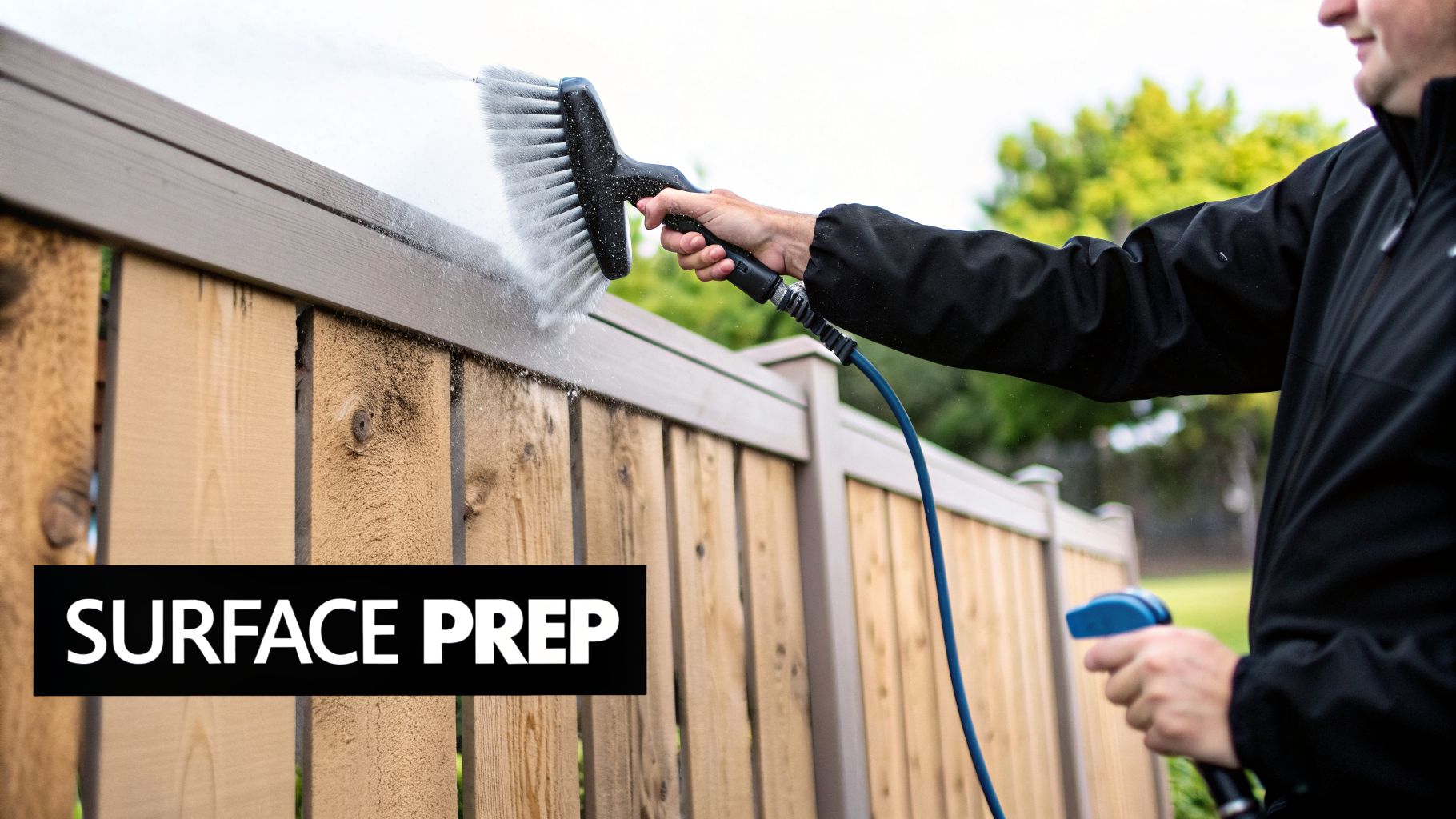
First things first, you have to get that fence clean. For most fences here in Colorado, that means firing up a power washer to blast away years of caked-on grime. But there’s a right way and a wrong way to do this.
- Go easy on the pressure: Start with a setting around 1500 to 2000 PSI. Any higher, and you risk permanently gouging and scarring softer woods like cedar or pine.
- Keep your distance: Hold the nozzle a steady 12-18 inches away from the wood.
- Sweep, don’t blast: Use a wide fan tip (25 or 40 degrees) and move in smooth, overlapping strokes that follow the wood grain. The goal is to lift the dirt off, not drive it deeper into the wood.
Following the wash, the next phase is not many steps but it is extremely important: allow the fence to air dry thoroughly. Painting or staining wet wood is just inviting trouble. The moisture that gets enclosed under the surface at some point will try to get out and in doing this it will lift the layers of the stain so that they will peel off in big sheets.
Especially in our dry region, it is best to allow at least 24-48 hours of nice and sunny weather for getting it completely dry before you stain. Our guide on preparing a deck for staining offers more great tips that work just as well for fences.
Comparing Application Techniques for a Flawless Finish
Once you have a perfectly clean and dry canvas, how you apply the stain makes all the difference in the final look and its durability. You’ve got three main choices.
- Brushing: This is the old-school method, and for good reason. It gives you maximum control and physically works the stain into every pore and crevice of the wood. It’s slow, no doubt, but the penetration is unmatched.
- Rolling: A decent middle ground. It’s definitely faster than brushing on the flat faces of the pickets, but it’s clumsy around the gaps and doesn’t push the stain into the wood grain quite as effectively.
- Spraying: This is by far the fastest way to get the product on the fence. An airless sprayer can cover a huge area in a fraction of the time. The biggest drawbacks are the potential for an uneven coat and the dreaded overspray that can drift onto your house, your plants, or your neighbor’s car.
One of the best professional methods for a durable finish is a hybrid technique known as ‘back-brushing.’ We treat a small control section of the fence by spraying to put the stain quickly, then right after that, we use the brush to really push the stain down into the wood grain.
Doing it in two steps is a method that combines spraying for speed with brushing for depth effectively. Not only does it smooth out the drips but it also provides an impeccably uniform coat and it works the stain in every nook and cranny. That’s the key to a finish that not only appears gorgeous but also stands the test of time.
Besides detailed preparation and application, thinking about the selection and installation of post caps to preserve the fence’s health is something very important too. So, in the end, it is these extra steps that make a big difference between just changing the color quickly and making a real, long-term investment in the property.
To DIY or Hire a Pro? Making the Call on Your Fence Staining Project
You’ve picked out the perfect stain, now comes the big question: who’s going to apply it? Deciding whether to tackle your fence staining project yourself or bring in a professional really boils down to balancing your budget, your free time, and how perfect you want that final finish to be.
Doing it yourself can be a fulfilling way to pass the weekend, however, it is certainly more than just a simple “brush and go” job. For doing it properly, you may have to rent or buy some serious tools. A pressure washer to really clean the wood, sanders to remove any fuzz or splinters, and most likely an airless sprayer if you want to cover a large area quickly are what we are talking about.
Even with a sprayer, the devil is in the details. You’ll need the right accessories, like a specific tip filter designed for fine enamel stain, to avoid constant clogging and get a smooth coat. The biggest pitfall we see with DIY jobs is an inconsistent finish. Without proper technique, you end up with drips, obvious overlap marks, and a stain job that starts to fail way sooner than it should.
When to Call in a Professional Staining Company
Hiring a local crew like I PAINT STUFF is an investment in getting the job done right, efficiently, and with a guaranteed beautiful result. We don’t just show up with a brush; we arrive with commercial-grade equipment and access to premium stains designed to withstand Colorado’s brutal sun and snow.
More importantly, we bring experience. We know exactly how a thirsty cedar fence soaks up stain compared to pressure-treated pine, and we adjust our whole process to match the wood. This kind of know-how ensures the stain penetrates deeply into the grain for a uniform look and maximum protection.
Frankly, the main driver for most people to call us is just to be worry-free. A professional takes care of all the dull prep work, constantly keeps overspray under control, and supports the job with a guarantee. It not only frees you up a lot of time but also removes the danger of a DIY mishap.
So, how do you choose? If you’ve got the time, own or can rent the right gear, and have the patience for careful prep and application, a DIY project can be a real success.
However, if you are a homeowner who wants an impeccable, very durable finish that will also increase the attractiveness of your home without involving a lot of work, hiring a professional is the best option for you. It is the most reliable option if you want your home to be done perfectly the first time, resulting in a stunning fence that is shielded from weather conditions right from the first day.
Common Questions About Staining a Wood Fence
Even a very detailed plan is not going to answer every single question. So before you start it, lets us answer the most common questions we get from Colorado homeowners. Working out these last details is the difference between a good DIY job and a professional-looking finish.
How Often Should I Restain My Fence in Colorado?
Our intense, high-altitude climate really puts stains to the test, which means our maintenance schedules are a bit shorter than in other parts of the country. A transparent stain will typically need a fresh coat every 1-2 years. You can expect 2-4 years from a good semi-transparent stain, while a high-quality solid stain can go 5-7 years or even longer.
A fence that has faced the full brunt of southern sun all day will have to be looked after very soon as compared to one that is mostly in the shadow. The best way is to carry out a quick check of your fence once a year so that you can spot any discoloration or damage ahead of time and prevent it from becoming a big problem.
Can I Put a Water-Based Stain Over an Old Oil-Based One?
This is a common question, and the answer is a hard no, at least, not without some serious prep work. Simply painting a water-based stain over an old oil finish is a recipe for disaster.
You can’t just coat an existing oil-based stain with a water-based product. The new acrylic film has nothing to bond with, and you’ll see it start to peel and flake off in sheets, often within the first year.
If you’re set on switching from oil to a water-based system, the old oil stain has to come off completely. That means using a chemical stripper and sanding the wood back down to a raw, porous state. It’s the only way to guarantee the new stain will actually adhere and protect your fence.
Is It Better to Spray or Brush on Fence Stain?
For the best possible result, the answer is actually both. Spraying is incredibly efficient and is the fastest way to get the material onto the fence, but it doesn’t do a great job of working the product into the wood grain. It just sits on top.
Back-brushing is the solution here. The method is very easy:first, you spray a part of the fence and then almost simultaneously, you take a brush and with force, you work the stain down to the wood’s pores. This 2-step operation allows you to enjoy the speed of a sprayer along with the deep penetration and even finish of a brush. Without any doubt, it is the best way to make sure that your fence is getting maximum protection and a durable finish.
Ready to skip the guesswork and ensure your fence gets a flawless, professional finish that will last for years? The team at I PAINT STUFF has the right tools and deep experience to protect your investment and make it look fantastic. Get your free, honest estimate today!
