
How Long Should Exterior Paint Last: A Guide for Colorado Homeowners
Most of the time, when homeowners ask, “How long should the exterior paint last?” they are dreaming of a period of ten years or more. However, due to the harsh weather conditions in Colorado, the real situation is rather different. A top-notch painting job in cities like Westminster or Boulder might still look great for about 5 to 10 years, at the most.
This range is wide, and it boils down to two things: the surface being painted and the quality of the paint.
The True Lifespan of Exterior Paint in Colorado
You can compare house paint to a nice winter coat. You can opt for the cheapest and plainest jacket and it will be adequate for you a couple of seasons only; however, a good high-performance, technical parka is actually a wise investment that can keep you warm for years.
This example can also be used for exterior house painting; mainly, the factor of how long it will last is the quality of the paint that you use and the condition of the surface that will be painted.
For homeowners from Northglenn to Lafayette, it’s important to have realistic expectations. The national averages you might see online simply don’t apply to our unique environment. Colorado’s combination of high-altitude sun, wild temperature swings, and the occasional hailstorm is incredibly tough on paint. A finish that might last 12 years in a milder climate could fail in as little as 7 years here in places like Thornton and Superior.
Lifespan by Surface and Quality
The exterior siding of your home is basically the surface for your paint, so selecting the appropriate siding material is very crucial since the siding material will determine the durability of the paint and its adhesion quality. Wood, stucco, and fiber-cement, for example, are very different and have different features.
- Wood Siding: Wood offers a classic look, but it’s also prone to absorbing moisture, which can cause it to expand and contract with temperature changes. This movement puts a lot of stress on the paint film, often giving it the shortest lifespan. If you have wood, deciding between paint and stain is a critical first step.
- Stucco Siding: Porous, masonry-type surfaces tend to hold the paint very tightly. The biggest problem with this surface is, however, cracking. When moisture through even a tiny crack gets behind the paint, it results in bubbles and peeling over a large area.
- Fiber Cement Siding: Due to its nature as a very stable, manufactured material, fiber cement works well for painting. It has very little movement due to changes in temperature and humidity and it also holds back the moisture, so the paint can remain beautiful and undamaged for a long time particularly if a high-quality paint is used on it.
So that you can get a better idea, we have created a comparison chart illustrating what a paint job in the Boulder-to-Westminster area can offer you on a realistic basis, according to your siding and the grade of the paint you apply.
Estimated Paint Lifespan in Colorado by Surface and Quality
|
Surface Material |
Standard Quality Paint |
Premium Quality Paint |
Key Colorado Considerations |
|
Wood |
4-7 years |
6-8 years |
Highly susceptible to UV damage and moisture absorption, leading to faster peeling and fading in areas like Boulder and Superior. |
|
Stucco |
5-8 years |
7-10 years |
Prone to hairline cracks from freeze-thaw cycles in Westminster and Thornton, which can compromise the paint film. |
|
Fiber Cement |
7-10 years |
10-15+ years |
Very stable and resists UV and moisture well, making it the best surface for paint longevity in Lafayette and Northglenn. |
Ultimately, the data shows that the type of siding and the quality of paint are the two biggest factors in determining how long your exterior will look great and stay protected.
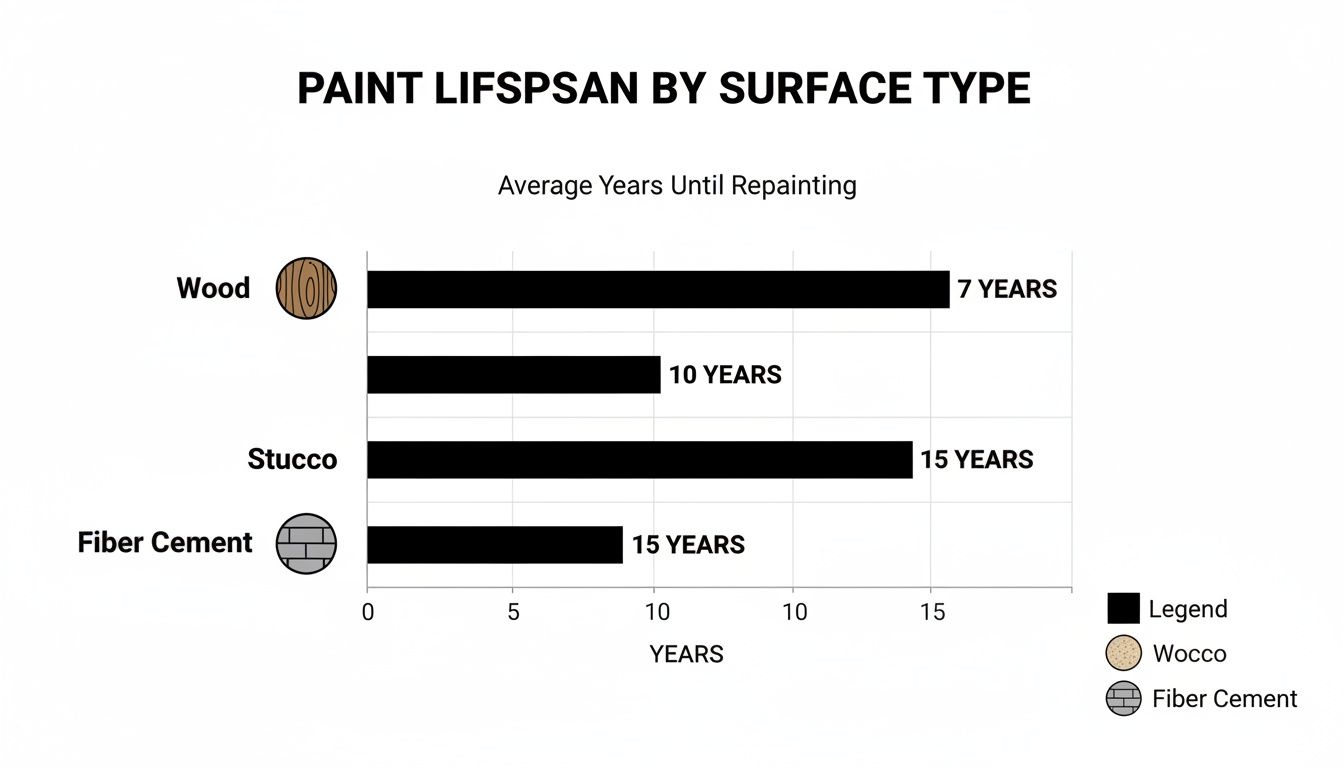
Buying premium paint is literally like giving a new lease of life to your exterior several times over, especially when paired with a high-quality fiber cement surface. The original cost is in fact rarely a waste as it has the effect of postponing both the need and cost of a complete repaint significantly in the future.
How Colorado’s Climate Attacks Your Paint Job
If you’ve lived in the north Denver metro area for any length of time, you know our weather is anything but gentle. That beautiful paint job isn’t just for looks; it’s your home’s first line of defense against a climate that seems determined to break it down.
The question “how long should exterior paint last?” has a very different answer here in Westminster, Thornton, and Boulder than it does in milder parts of the country. To really get it, you have to understand the three main ways our local weather wages war on your home’s exterior.
The Relentless High-Altitude Sun
Those beautiful, sunny days we love so much in Superior and Lafayette are public enemy number one for exterior paint. Our high elevation means the sun’s ultraviolet (UV) radiation is far more intense and damaging.
Imagine UV rays as an ongoing invisible sandblaster that is slowly eroding your siding. They not only directly affect the paint by attacking, breaking down, and destroying the chemical binders, but also destroy the very glue that keeps color pigments together and gives the paint a protective layer. Such a breakdown of the paint, termed photodegradation, manifests itself in two different ways:
- Fading: You’ll notice the vibrant color of your home fading to a dull, washed-out look. This is most obvious on the south- and west-facing walls, which bake in the sun all afternoon.
- Chalking: When you run your hand over the siding and there is a powdery residue left on your hand, that indicates the siding is chalking. Chalking is a sign that the paint’s binders are failing and the coating is beginning to break down. This is the reason why paint jobs in our local communities have a much shorter lifespan. Originally, the paint forms a united protective cover, but this cover becomes hard and fragile and consequently, it cannot protect the paint against any harmful effects of weather.
For more information about paint that protects from sunlight, go to our page about choosing exterior paints for sun exposure.
The One-Two Punch of Hail and Wind
The inhabitants of towns such as Thornton and Northglenn have long known about summer hailstorms. Usually, we first think of our roof or car; however, hail can also seriously damage siding and paint. In fact, every hailstone is a small hammer that can cause chips, dents, and micro-fractures on the paint surface.
One storm can leave thousands of these tiny impact points. Even a tiny chip can be a fresh entry point for water to seep through the paint. This can eventually cause the paint layer to peel and bubble. Besides, if you are in Colorado, knowing how hail damage can affect your car is useful, as it is not only the paint that gets damaged.
The Destructive Freeze-Thaw Cycle
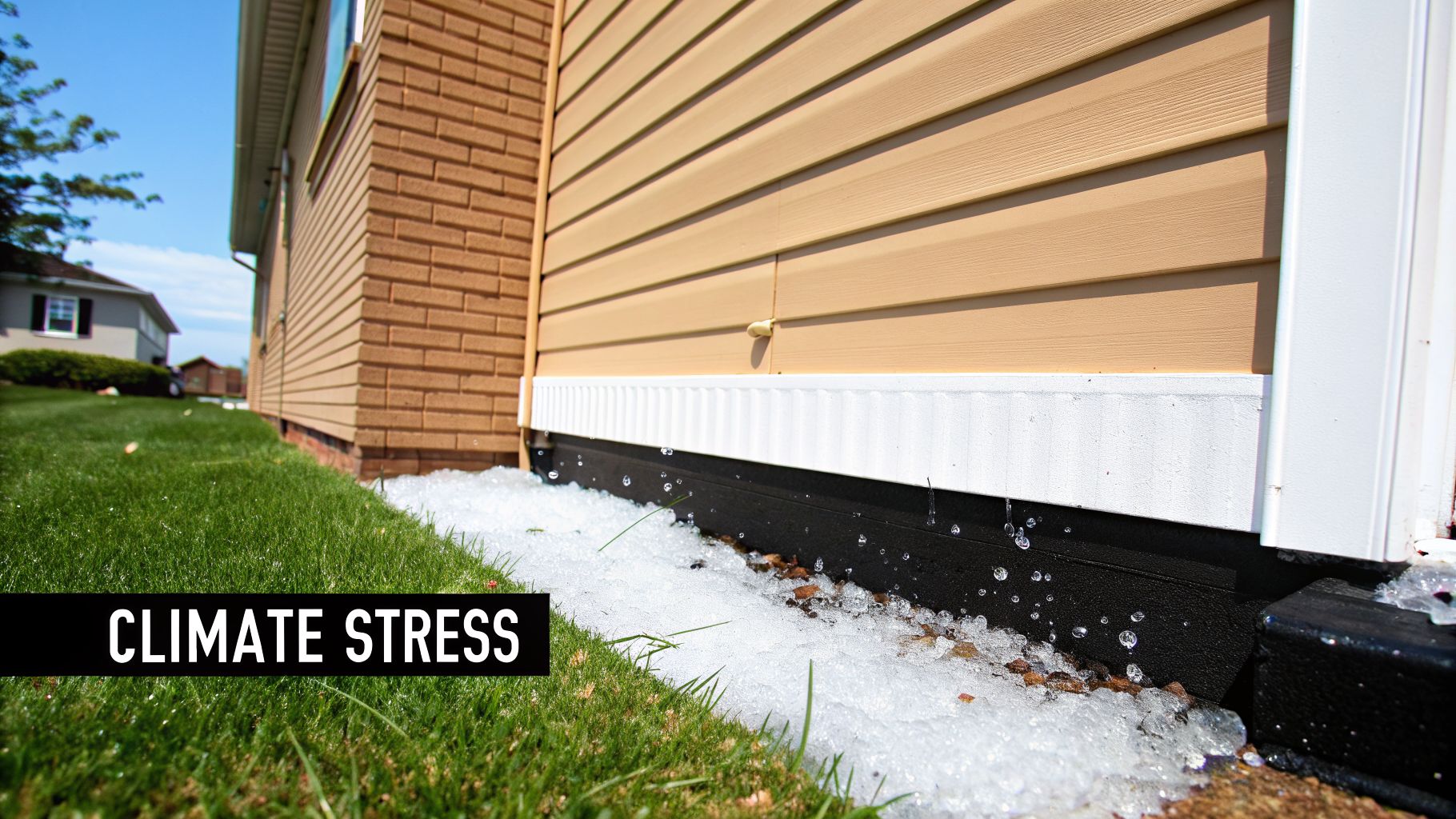
Finally, this is probably the most famous weather pattern that is responsible for the entire Front Range from Boulder to Westminster, the freeze-thaw cycle. It is a quiet, but extremely powerful force of nature.
Imagine a calm winter day with a temperature above zero when melting snow or condensation enters through a tiny crack in the paint layer of your house. The water remaining inside the crack turns into ice during very cold nights, and the growing pressure of the ice breaking the paint is just like an ice cube tray filled to the brim, and the ice overflows the tray when it is put in the freezer.
This expansion widens the crack a little more. The next day it thaws, more water gets in, and it freezes again that night. This cycle repeats itself countless times each winter in Lafayette and Superior, turning tiny, invisible flaws into major paint failure and giving moisture a direct path to rot the wood underneath.
The 4 Pillars of a Durable Paint Job
Have you ever noticed how one neighbor’s house in Westminster still looks amazing ten years after the last paint job, while another one in Thornton is already peeling in just four years? It is not a matter of chance. The secret to a long-lasting exterior paint finish, especially in our part of Colorado, is based on four major factors.
Think of it like building something to last. If any one part is weak, the whole structure suffers. When it comes to your home’s paint, getting these four things right is the only way to ensure you get the most life out of your investment.
Pillar 1: Surface Preparation
In fact, this is probably the most vital step of the whole project. Buying the highest quality paint is great, but if your surface is dirty and peeling, you will waste your money. It’s guaranteed to fail.
Prep work is the unglamorous, behind-the-scenes hero of a great paint job. It’s the foundation. You wouldn’t build a house on shaky ground, and the same goes for paint. This involves a few non-negotiable steps:
- Power Washing: This blasts away years of chalky residue, dirt, and pollen that act as a barrier between the new paint and your siding. For an incredible bond that withstands Colorado weather, you have to start with a clean surface. Understanding the pressure-washing process for your house before exterior painting nearby makes it clear why pros never skip it.
- Scraping and Sanding: All that old, failing paint has to go. We physically scrape off anything that’s loose and then sand the edges to “feather” them. This creates a perfectly smooth transition so you don’t see the patch marks under the new coat.
- Priming: Any bare wood or metal areas require priming with a high-quality primer. This step will not only seal the material but will also prevent old stains from showing through. Furthermore, it provides a strong, even base for the topcoat to adhere effectively to.
Paint will not be able to carry out its function without careful preparation. Welding a protective shield to your house is a metaphor that accurately represents the situation, rather than just slightly taping it on.
You can refer to our guide on how to prepare your home for painting to get detailed information on these essential steps.
Pillar 2: Material Quality
The old saying “you get what you pay for” is absolutely true when it comes to paint. A premium can of paint might cost 30-50% more per gallon, but the better ingredients inside pay for themselves through sheer durability.
High-grade paints contain larger quantities of premium binders (literally the “glue” that holds the components together) and stronger UV-blocking agents. Such ingredients result in a durable but flexible paint layer that moves with (and withstands) the dramatic temperature changes from Lake Superior to Boulder, meanwhile resisting the strong sunlight without any color change.
Pillar 3: Application Technique
Indeed, the method is equally important as the content. An experienced painter in your area understands precisely the right technique to lay down paint. If the coat is too thin, it will not provide any real protection; on the other hand, if it is too thick, it may sag or crack eventually.
A professional spray application lays down a beautifully even coat, covering large areas with perfect consistency. But the real craft comes next: back-brushing. This is where an expert works the paint into every tiny nook and cranny of the wood grain or stucco, creating an airtight seal against moisture.
Pillar 4: Local Expertise
In the end, a paint job that really lasts is one that meets its environment. A skilled painter who has knowledge of the Front Range microclimates, from Westminster and Thornton to Lafayette, is the one who experiences which parts of the house are affected by sun and snow.
This insider insight gives a professional the opportunity to make clever tweaks, like applying a particular primer on the wall getting the most sun or suggesting a brand that is well-known for delivering excellent results in the dry and high-altitude climate of our area. The idea is to create a finish that is tailor-made for your house, exactly at the place it is located in Northglenn or Boulder.
Warning Signs Your Colorado Home Needs Repainting
Knowing the average lifespan of an exterior paint job is helpful, but the real key is learning how to spot the first signs of trouble. Your home’s paint job is constantly telling you how it’s holding up; you just have to know what to look for. Catching a problem early in a place like Westminster or Boulder can be the difference between a simple, affordable fix and a costly, full-blown siding replacement.
Sure, everyone spots dramatic peeling and chipping. But it’s the quieter, more subtle signs that are often the most critical. Think of them as the check engine light for your home’s exterior; ignoring them only leads to bigger, more expensive headaches down the road.
Decoding Subtle Paint Failure
Paint doesn’t just give up all at once. It’s a slow breakdown, and the intense UV radiation we get along the Front Range, from Superior to Northglenn, puts that process into overdrive. By learning to recognize early warning signs, you can take action before moisture gets in and causes real damage, like wood rot.
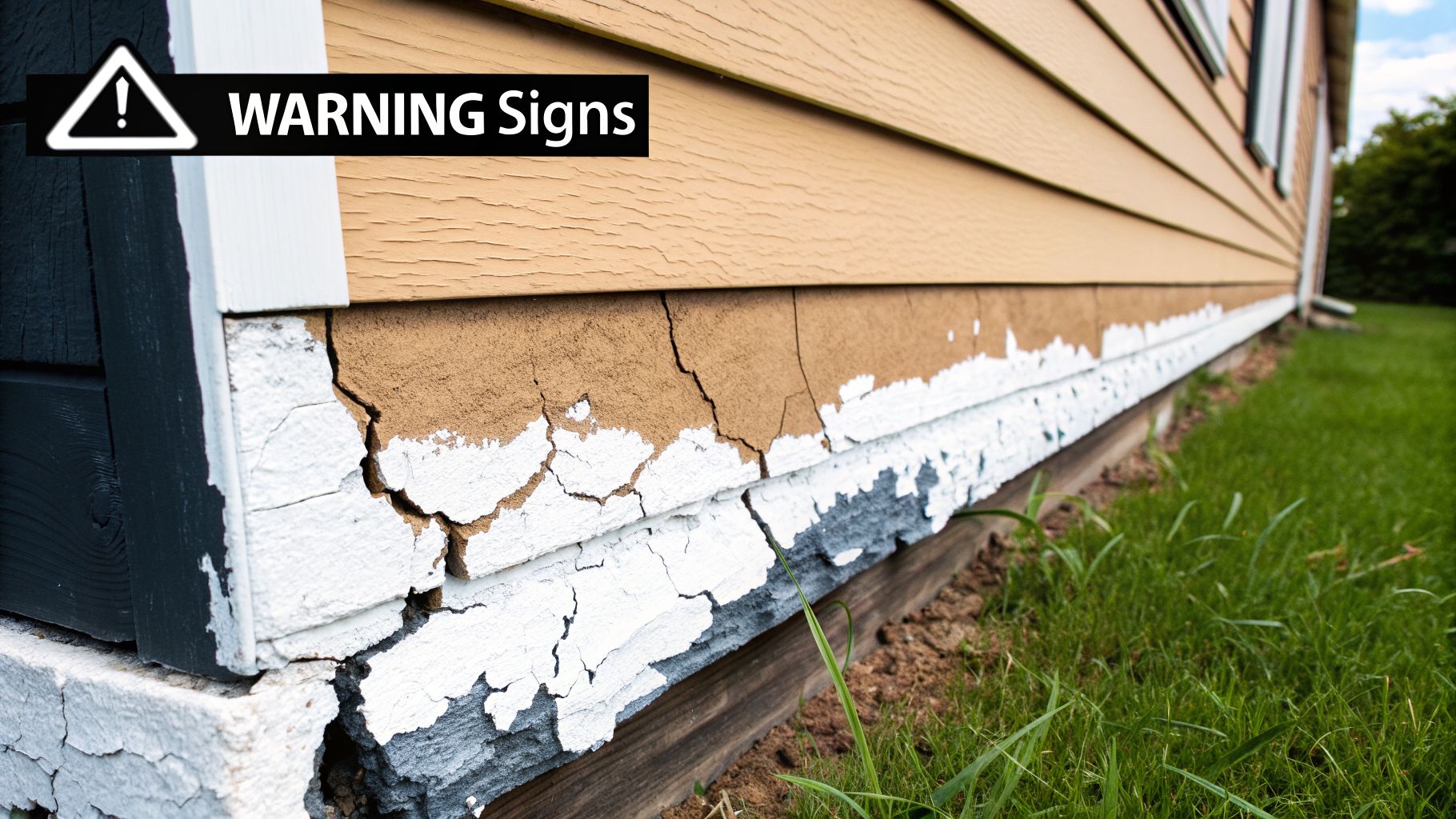
One of the first tell-tale signs we often see is chalking. Go run your hand across a section of your siding. If you pull it back covered in a fine, powdery residue, that’s chalking. It means the sun has broken down the paint’s binders, the very “glue” holding the pigment together. The paint film is becoming brittle and losing its ability to protect your home.
Another big warning sign is alligatoring. It literally looks as if a network of split lines mimicking the pattern of lizard skin is spread all over the surface. This is caused by the fact that the layer of paint on top grows too stiff to be able to get bigger and smaller,cabi keeping pace with your siding throughout the crazy temperature changes in Colorado. When you notice this, it’s a huge signal that the paint is no longer protecting the material below.
Think of your home’s paint as its skin. Chalking is like dry, flaky skin that’s lost its moisture. Alligatoring is like deep, painful cracking. Both are signs that the protective barrier is compromised, leaving the structure beneath exposed to the elements.
The Visual Checklist for Your Home
Besides chalking and alligatoring, several other visual signs clearly indicate, “You must begin planning your repaint!” When you are out next time, take a stroll over your house in Thornton or Lafayette and notice these problems:
- Significant Fading: Examine the side of your house that faces the south and compare it to the one that faces the north. If the paint on the south-facing wall is much lighter, that means that the sun’s UV rays have broken down the pigments in the paint. This goes beyond just being an eyesore, as it indicates that the paint’s ability to protect is greatly reduced.
- Cracked or Shrinking Caulk: The sealing of your windows, doors, and trims basically forms your first line of defense against water intrusion. Once you notice the caulking detaching from the surface, getting cracks, or it might be crumbling, then essentially, it has served as a direct channel for moisture to penetrate your walls after it has gotten behind the siding of your home.
- Bubbling or Blistering: Those little bubbles or blisters in your paint are pockets of trapped moisture or air. They often point to a deeper problem, indicating that water has penetrated behind the paint film, either from a leak or from moisture wicking up into the siding itself.
- Visible Mildew or Mold: Be on the lookout for dark, streaky stains that thrive in damp, shaded areas of a home. While you can sometimes clean mildew off, its very presence means moisture is hanging around on the surface; a clear sign the paint is no longer doing its job of repelling water.
If you see any of these problems, it is a clear sign that your paint protective life is almost over. The best way to maintain your home’s value and structure is by dealing with it right away.
DIY Versus Hiring a Professional Painter for Your Front Range Home
Sooner or later, every homeowner from Westminster to Boulder looks at their house and thinks, “It’s time for a new coat of paint.” The very next thought is almost always, “Can I just do it myself?” On the surface, the DIY approach looks like a great way to save a bundle on labor. But before you head to the hardware store, it’s worth taking a hard look at what that really entails.
Residential painting near you is a large task. We don’t merely mean a handful of paint cans. The hidden expenses that slowly accumulate include the rental of scaffolding and a professional sprayer, the purchase of ladders, rollers, brushes, and drop cloths. Besides the money, you are also giving up your weekends, and possibly a week or two of your holiday, to hard physical work, much of which is done high up on a ladder.
The True Cost of a DIY Paint Job
Beyond the equipment and the sheer time commitment, the biggest landmine for any DIY painter is simple human error. As we’ve covered, proper surface preparation is everything. It’s the one thing that will make or break your paint job, and it’s where most DIY projects go wrong.
One can easily overlook the extensive effort and detail that proper paint surface preparation demands: cleaning, sanding, and priming thoroughly. When you don’t do a thorough prep, chances are that the fresh paint won’t adhere well. In fact, you might even experience chipping, blistering, and cracking paint soon, and then you will be at the starting point, looking at another costly and laborious cycle.
The initial savings from a DIY job can quickly evaporate if the paint fails early. A professional job that lasts 8-10 years provides far more long-term value than a DIY effort that needs redoing in 3-4 years.
The Value of Professional Expertise
When you hire a professional painting company nearby in Thornton or Lafayette, you are not merely forking over some money to a person who will just put paint on your walls. In fact, you are making an investment towards getting the job done exactly as you want it the very first time so that you will enjoy the results long after the work is done without having to worry. An experienced painter that is a genuine professional will have a combination of skills and know-how that even a very talented and experienced homeowner would find very difficult to match in terms of time and quality.
Here’s what you’re really paying for:
- Climate-Specific Knowledge: A local painter knows Colorado. They’ve seen firsthand what the intense UV radiation in Superior does to siding and which products can handle the constant freeze-thaw cycles we get in Northglenn.
- Efficiency and Safety: A professional team has the right tools and a streamlined process to finish the job safely and quickly. Plus, they’re fully insured, which means you aren’t on the hook if an accident happens on your property.
- Access to Materials: Professional painters don’t buy their supplies where you do. They rely on contractor-grade paints and primers that are more durable and have a longer lifespan than the ones you can find at the big-box stores.
- Guaranteed Results: Any reputable painter will stand behind their work with a solid warranty. If something goes wrong because of the prep work or application, they’ll come back and fix it. That’s your investment protected.
After all, it basically depends on your individual capabilities, time availability, and the degree of risk you are willing to assume. Doing it yourself can be quite gratifying; however, employing a professional is a move that guarantees your painting job will not only be a good-looking one but also a protective one for your house for several years. Should you feel that a professional is the right choice for you, our article on how to hire a painter is an excellent resource.
How to Extend the Life of Your Exterior Paint
After the painters have packed up their equipment and your home appears to be completely renovated, the work of preserving it starts. A little effort every year can quite likely extend the lifespan of your paint for many years. Consider it not so much a task but more as saving a valuable investment.
Our advice to homeowners is to perform a basic inspection by simply walking around their property every spring. It doesn’t matter if you are living in Westminster or Boulder; all you need is a few minutes to take a good look at the ones that stand out as signs of deterioration: tiny cracks, minor peeling, or caulking that seems to be pulling away from your windows. Discovering these troubles while they are still small is the trick.
Simple Maintenance for a Longer-Lasting Finish
An annual washdown does more for your paint than you might think. Just use a soft-bristled brush and a regular garden hose to rinse away the grime, dust, and pollen that gets caked on by the intense Colorado sun. Whatever you do, stay away from high-pressure washers. They can blast paint right off the wall and force water behind your siding, creating much bigger problems.
A small fix today prevents a major headache tomorrow. Sealing a tiny crack in the caulk might take five minutes, but it stops moisture from seeping into your walls and causing wood rot, a far more expensive repair down the road.
Lastly, attend to small touch-ups immediately. Even if a scrape caused by a ladder or a chip produced by a lawnmower is negligible, they are just doors left wide open for moisture to penetrate, so beware! You should have a small, tightly closed container of leftover paint and a small brush ready for these fast repairs. This is the simplest method of maintaining the protective paint barrier of your paintwork.
For more expert advice, check out these little-known tricks for long-lasting paint finishes.
Your Top Exterior Painting Questions, Answered
If you live in Westminster, Boulder, or other residential areas like Lafayette or Thornton and own a house, you must have wondered a couple of times how to maintain your home’s exterior looking good. Here is a compilation of the most common questions we get from our neighbors, and especially their answers.
Does Paint Color Affect How Long It Lasts in Colorado?
It definitely does. For example, consider a dark-colored car and a white one being parked in the sun; the dark car’s surface temperature will be much higher than the white one. This simple fact is also valid for your home. Darker colors contain the ability to absorb more heat and UV light of our harsh, high-altitude sun. That will cause the colors to fade and the paint to deteriorate much sooner than the lighter ones.
The good news? This doesn’t mean you have to stick to beige. Choosing a high-quality paint with built-in UV inhibitors makes a huge difference and will go a long way in protecting even the boldest, darkest colors.
How Often Should I Wash My Home’s Exterior?
For general upkeep in areas like Thornton or Northglenn, a gentle wash every 1 to 2 years is a good rule of thumb. A simple rinse with a garden hose or a low-pressure nozzle is all it takes to remove the dust, pollen, and grime that can slowly eat away at your paint.
Just be careful not to confuse this with a full-blown power wash. That’s a powerful preparation tool best left to the pros right before a new paint job. It’s designed to strip away everything down to the surface to ensure the new paint can grip on tight.
What Is the Best Time of Year to Paint in the North Denver Metro Area?
The sweet spots for exterior painting in Colorado, from Lafayette to Superior and Boulder, are late spring and early fall. We’re looking for that perfect stretch of dry days where temperatures stay reliably between 50°F and 90°F.
This is precisely the sort of soft weather that paint requires to harden properly; that is, to become a strong and long-lasting protective “shell.” We make it a point never to paint when it is blazing hot mid-summer and also when the weather is turning cold as in late fall and winter; these are the main culprits that can spoil the paint and cut its lifespan short.
Ready to give your home a durable, beautiful finish that stands up to the Colorado climate? The local painting contractor at I PAINT STUFF provides fast, free estimates for homes in Westminster, Thornton, Northglenn, Lafayette, Superior, and Boulder. Protect your investment and elevate your curb appeal by getting your free quote today!