

When it comes to choosing the best paint for stucco houses, you’re really looking for a coating that can do two things at once: protect and breathe. This is especially true for homes here in Colorado. The top contenders are 100% acrylic latex paint, known for its fantastic breathability and color retention, and elastomeric paint, which offers unmatched waterproofing and flexibility to cover up tiny cracks. This guide also offers actionable insights for related interior projects, like painting kitchen cabinets to complement your home’s unique style.
Want it done for you? I PAINT STUFF offers stucco painting services with free, written estimates. Call (720) 263-7210.
Your Guide to Painting a Stucco Home in Colorado
Stucco is a classic, durable siding, but its porous and textured nature means it needs a very specific kind of paint. Think of your stucco walls like a high-end Gore-Tex jacket. It has to keep the rain and snow out, but it absolutely must let moisture vapor escape from the inside.
Slapping the wrong kind of paint on stucco is a recipe for disaster. It can trap moisture right under the surface, which leads to ugly blistering, peeling, and eventually, real damage to the stucco itself.
This is a huge deal for homeowners in places like Arvada, Thornton, and Broomfield. Our intense sun and constant freeze-thaw cycles put a tremendous amount of stress on a home’s exterior. The right paint acts like a flexible shield, expanding and contracting as temperatures swing and standing strong against UV rays.
Comparing Top Paint Choices
So, how do you choose? It really comes down to the current condition of your stucco.
If you have an older home in Wheat Ridge that’s starting to show a web of hairline cracks, an elastomeric coating is going to be your best friend. But for a newer home in Commerce City with stucco in great shape, a high-quality acrylic paint is often the perfect fit.
Let’s break it down a bit more with a quick comparison.
Quick Comparison of Top Paints for Stucco
This table gives you a side-by-side look at the best paint options for stucco exteriors, focusing on their primary features and benefits.
| Paint Type | Key Benefit | Best For | Average Lifespan |
|---|---|---|---|
| Elastomeric Paint | Ultimate waterproofing and flexibility | Stucco with existing hairline cracks | 7-10+ Years |
| 100% Acrylic Latex Paint | Superior breathability and color fastness | Stucco in good to excellent condition | 5-10 Years |
Choosing the right coating is a smart investment, and it’s a decision more and more homeowners are making. In fact, the global stucco market, which includes these vital protective paints, was valued at a whopping USD 12.3 billion in 2024 and is only expected to grow. You can dive deeper into the stucco market trends over at imarcgroup.com.
As you start planning your project, don’t forget to think about how your new paint color will work with your roof. A great resource for this is this expert guide to exterior paint and roofing color combinations.
And for more local tips tailored to our unique climate, be sure to check out our own guide on the top tips for exterior house painting in Denver.
Decoding The Best Paint Types For Stucco Surfaces
Stucco has a unique, porous texture that not just any paint can handle. Choosing the right paint for stucco houses is a lot like picking the right gear for a Colorado winter—it has to be protective, durable, and, most importantly, breathable. If you get it wrong, you risk trapping moisture inside your walls, which leads to the blistering, peeling, and costly repairs that no homeowner in Sherrelwood or Twin Lakes wants to deal with.
Let’s break down the science behind the best options. The two main players in the game are elastomeric coatings and 100% acrylic latex paints. Each one is a fantastic choice, but they’re suited for very different scenarios. Think of them as two different types of high-performance jackets for your home.
Elastomeric: The Waterproof, Flexible Shield
Elastomeric paint is the heavy-duty, waterproof parka of the paint world. It’s an incredibly thick and flexible coating that lays down a seamless, rubber-like barrier over your stucco. Its biggest selling point is its elasticity; it can actually stretch to bridge the hairline cracks that plague stucco homes in places like Wheat Ridge and Broomfield, thanks to our constant freeze-thaw cycles.
This high-build formula is a true problem-solver. If your stucco is a bit older and has a network of fine cracks, an elastomeric coating will fill them right up and stop water from getting in, protecting the very structure of your walls.
Acrylic Latex: The Breathable, Everyday Performer
On the other side, you have high-quality 100% acrylic latex paint. Think of this as a premium, breathable windbreaker. It provides excellent protection from the elements but, crucially, allows moisture vapor from inside the stucco to escape. This “breathability” is non-negotiable for preventing trapped moisture, which is a primary cause of paint failure and underlying wall damage.
For a home in Federal Heights or Berkley with stucco that’s already in good shape, acrylic latex is almost always the better choice. It offers fantastic color retention against the intense UV we get here in Arvada and Thornton, and it adheres beautifully without hiding the lovely, natural texture of the stucco itself.
Key Insight: The current condition of your stucco is the single most important factor in choosing the right paint. Elastomeric is a powerful fix for cracked surfaces, but its lower breathability can be a problem on healthy stucco. In that case, a top-tier acrylic paint is a more effective and appropriate solution.
Mineral-Based Paints: A Nod To Tradition
There’s a third category that deserves a mention: mineral-based paints like silicate or limewash. Instead of forming a film on top of the stucco, these paints create a chemical bond with it, becoming a part of the surface itself. They are unbelievably breathable and provide a unique, chalky matte finish that’s perfect for historic homes or anyone going for a more traditional, old-world aesthetic. For properties in historic Denver neighborhoods, this is a great way to maintain authentic character.
The popularity of stucco isn’t slowing down. In fact, the global market is expected to grow from USD 11.65 billion in 2023 to USD 17.04 billion by 2032. This growth is driven by stucco’s natural resilience, and specialized paints only enhance these qualities, offering serious protection against the exact challenges we see in Commerce City and Edgewater. You can learn more about this trend by checking out market forecasts on polarismarketresearch.com.
To make this even clearer, this decision tree helps visualize how to pick a paint based on your stucco’s current condition.
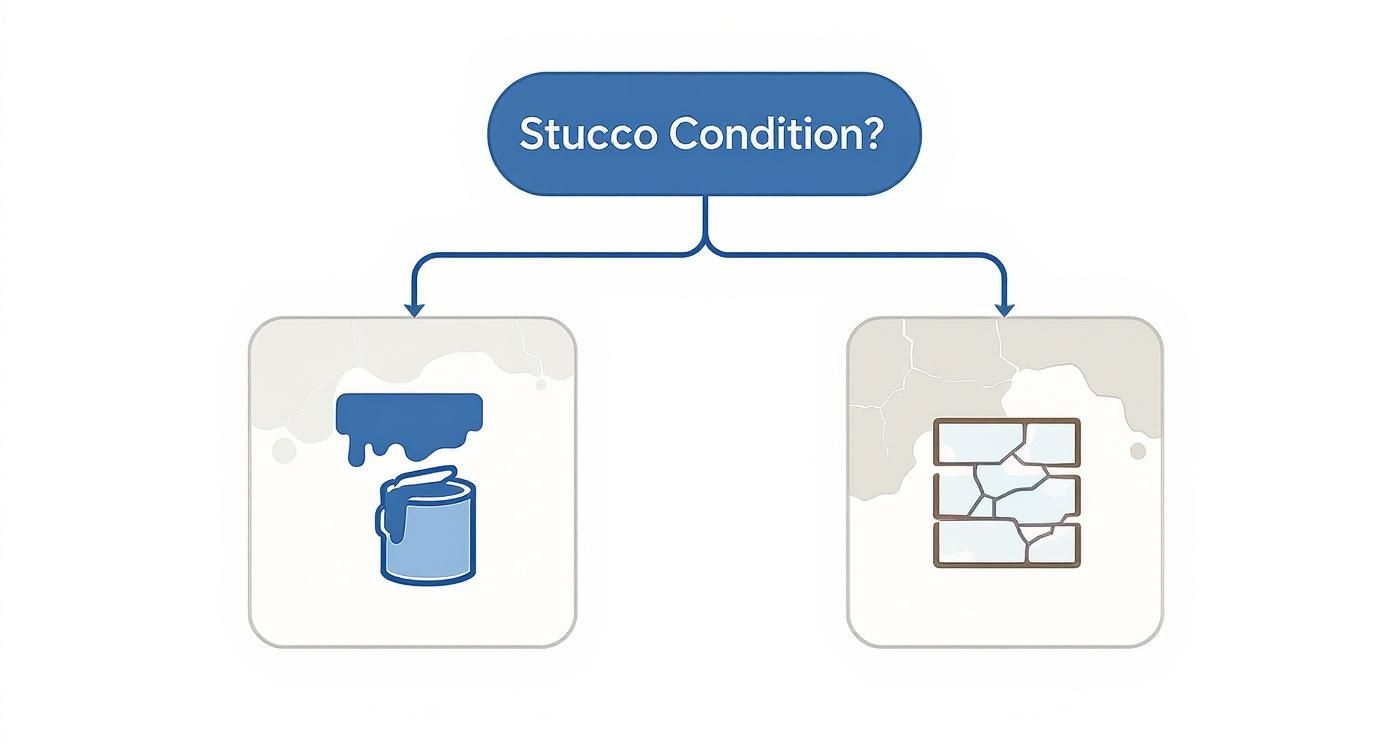
As the infographic lays out, the road to the right paint starts with a simple, honest look at your home’s exterior. Is it in great shape, or does it have cracks that need a more heavy-duty solution?
How to Prepare Stucco for a Flawless Paint Job
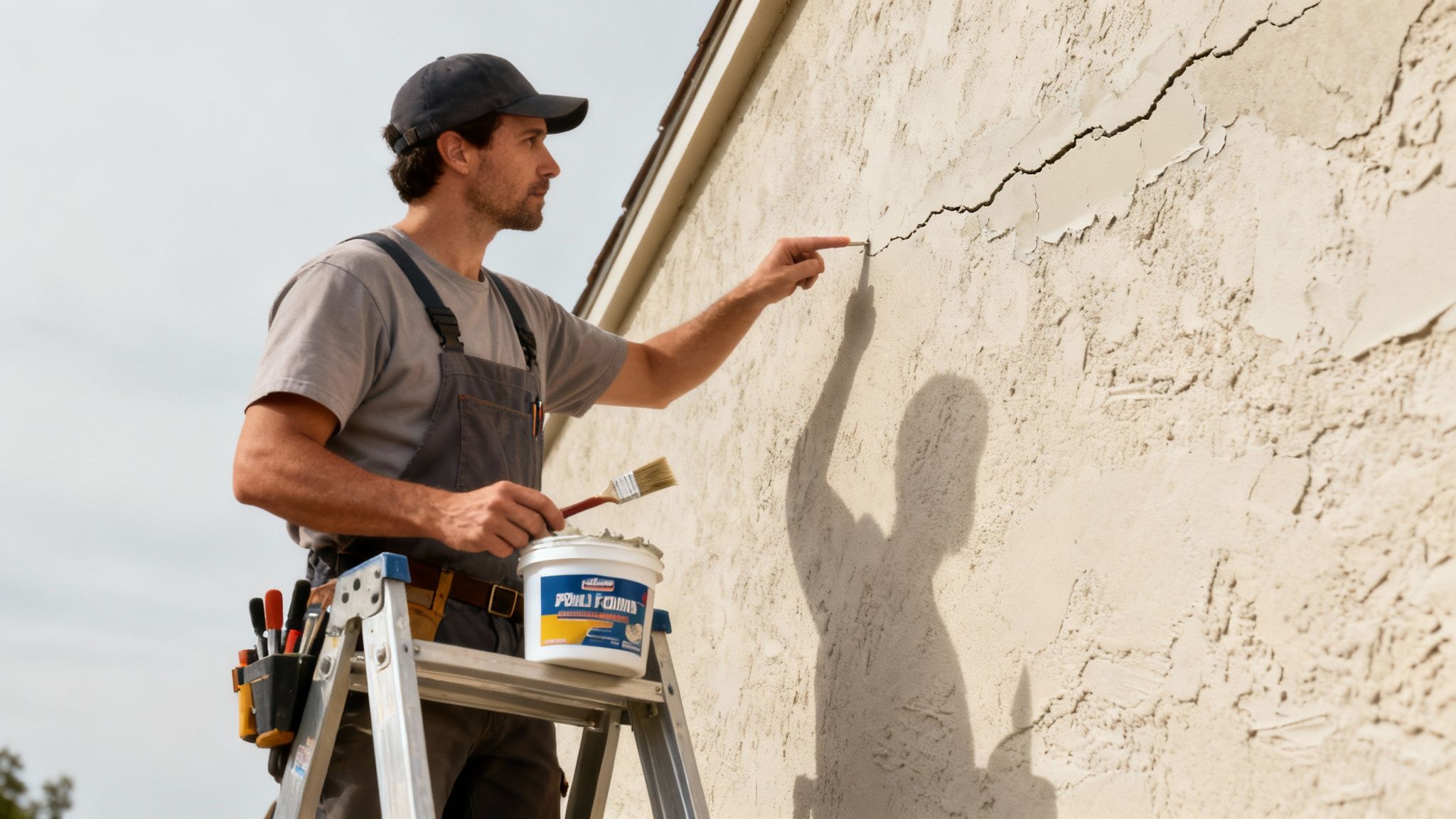
Ask any seasoned painter, and they’ll tell you the secret to a great paint job isn’t the final coat—it’s the prep work. This is especially true for stucco. For a flawless finish that stands up to the tough weather we get in Federal Heights and Commerce City, proper surface preparation is simply non-negotiable.
Think of it like this: you wouldn’t slap a new coat of paint over greasy kitchen cabinets in your Applewood home and expect it to stick. You’d clean, sand, and prime first. Your home’s exterior deserves that same level of care to ensure the finish looks professional and actually lasts.
Inspect and Clean the Surface
First things first, you need to play detective. Grab a coffee and take a slow walk around your home, whether you’re in Welby or Northglenn, and get up close with your stucco. You’re hunting for hairline cracks, tell-tale water stains, and that white, chalky residue known as efflorescence. That powdery stuff is just salt left behind by evaporating moisture, and it’s a paint-killer if you don’t get rid of it.
After your inspection, it’s time for a good cleaning. A simple rinse with a garden hose can knock off loose dirt and dust. If you’re dealing with more stubborn grime, a power washer can be your best friend, but you have to be careful. Stick to a low-pressure setting—somewhere between 1,500 and 2,000 PSI—to avoid accidentally blasting away the stucco’s texture.
Repairing Common Stucco Damage
Once your stucco is clean, every little flaw will be on full display. This is a good thing! Fixing these issues now is what separates a paint job that lasts three years from one that lasts a decade.
- Hairline Cracks: For those little spidery cracks, a high-quality elastomeric caulk is the perfect tool. It’s designed to stay flexible and move with your home as it settles, which keeps the crack from splitting open again.
- Larger Damage: If you’ve got bigger cracks or even chunks of stucco missing, you’ll need a dedicated stucco patching compound. This will let you build up the area and match the texture of the surrounding wall.
- Stains: Did the power washer leave behind some stubborn stains? Don’t just paint over them. A good stain-blocking primer will seal them in and stop them from bleeding through your fresh topcoat.
Taking the time for these repairs is a smart investment. A home in Applewood or Lexington with a well-prepped surface will hold its paint beautifully for years, while one where corners were cut will start showing its age much faster.
Pro Tip: Patience is key. After cleaning and patching, you absolutely must let the stucco dry completely. Give it at least 24 to 48 hours—more if it’s humid. Painting over a damp wall is one of the most common DIY mistakes, and it’s a guaranteed recipe for blistering and peeling.
The Critical Role of Primer
Alright, we’re almost to the fun part. Priming is the final step before you break out the color, and it’s arguably the most important. A quality masonry primer or conditioner is essential, especially for brand-new stucco or any surface that had that chalky efflorescence.
Think of primer as the ultimate handshake between the stucco and the paint. It grips the porous wall and creates a perfectly uniform, non-absorbent surface for your topcoat to stick to. Skipping this step is like trying to build a house on a shaky foundation—it just won’t end well. This step ensures your paint job looks even, adheres properly, and protects your home for the long haul.
Pro Tips for Applying Paint to Stucco
https://www.youtube.com/embed/_vDcSBDcBW4
Once your stucco is clean, repaired, and primed, the fun part begins—applying the color that will completely transform your home. But hold on. Painting a textured surface like stucco isn’t like painting a smooth interior wall. To get that flawless, professional-grade finish that actually lasts, you need the right tools and the right technique.
Choosing the right application method is a huge deal. It affects both the quality and the speed of your project. For homeowners in places like Sherrelwood, Twin Lakes, or Federal Heights, getting this step right means forcing the paint into every tiny nook and cranny, which is your best defense against the weather.
Choosing Your Application Tools
You’ve basically got three options for applying paint for stucco houses, and each has its place. The best choice really comes down to the size of the job and what you’re comfortable using.
- Thick-Nap Roller: Don’t even think about using a standard roller. You need one with a thick nap—at least 1 ¼ inch. This type of roller holds a ton of paint and has the depth to push it deep into the stucco’s rugged texture, so you don’t end up with a bunch of unpainted pinholes.
- Quality Brush: A good brush is non-negotiable. You’ll need it for “cutting in,” which is the detailed work of painting around windows, doors, and trim with a steady hand.
- Airless Sprayer: This is the tool of choice for pros, and for good reason. A sprayer atomizes the paint, delivering the fastest and most even coverage you can get. It coats the surface perfectly in a fraction of the time it would take to do by hand.
The secret to a truly bulletproof finish on stucco is a two-step process: spray the paint on, then immediately “back-roll” it with a thick-nap roller. This combines the speed of spraying with the brute force of rolling, pushing the paint into every last pore for a durable, uniform coat that looks fantastic.
Best Practices for the Colorado Climate
Painting here in Colorado is a different ballgame. The intense sun and dry air, especially in towns like Berkley, Arvada, and Thornton, can make paint dry almost as soon as you put it on. This can lead to ugly “lap marks” where your wet and dry edges overlap.
To beat the heat, always work in the shade. It’s as simple as that. Follow the sun around your house so you’re never painting in direct sunlight, especially during the middle of the day. This gives the paint enough time to level out smoothly.
And speaking of a smooth finish, applying two complete coats is non-negotiable. Think of the first coat as a heavy-duty sealer. The second coat is what provides that rich, even color and the critical UV protection homes in Welby and Northglenn desperately need.
Stucco is incredibly popular across North America, with the U.S. holding about 73.2% of the market share back in 2018, a trend you can read more about on polarismarketresearch.com. This just goes to show how critical it is to use high-quality, compatible paint for stucco houses to ensure these exteriors last for decades.
Bringing Stucco Finishes Inside Your Home

While we’ve focused on protecting your home’s exterior, a major trend in interior design involves bringing that unique, earthy texture of plaster and stucco indoors. We’re seeing it pop up all over the Denver metro area, from stunning fireplace surrounds to dramatic feature walls. This trend naturally leads to questions about complementary interior painting, especially for high-impact areas like kitchen cabinets.
When you bring a textured finish inside, the painting game completely changes. Instead of worrying about UV rays and hail, your main opponents are fingerprints, scuffs, and daily wear. This means your top priority is finding a paint with serious washability and scuff resistance.
Think about a custom plaster range hood in a Berkley or Edgewater kitchen. It’s an incredible focal point, but it’s also ground zero for grease, steam, and constant touching. A washable, durable paint is essential.
Choosing the Right Interior Paint and Cabinet Finishes
For interior plaster or textured walls, a premium acrylic latex paint is almost always your best bet. Forget the heavy-duty weatherproofing of exterior coatings; inside, you’re looking for toughness and cleanability.
When planning an interior update, here’s how to think about your surfaces:
- A Satin or Semi-Gloss Sheen for Walls: These sheens are far easier to wipe down than a flat or matte paint, making them perfect for kitchens, bathrooms, and hallways.
- Specialty Cabinet Paint: For kitchen cabinets in homes from Derby to Thornton, use a high-quality cabinet enamel. These paints are self-leveling for a smooth, factory-like finish and cure to a hard, durable shell that resists chipping and scratches.
- Low-VOC or Zero-VOC: This is crucial for interior air quality. Choosing a paint with low or zero Volatile Organic Compounds (VOCs) is a must for keeping your home’s air healthy.
A word of caution: Never be tempted to use leftover exterior paint for an indoor project. The chemical formulas are completely different. Using exterior paint inside can off-gas harmful fumes for months. To get the full picture, it’s worth reading up on why exterior paint shouldn’t be used inside.
A Complete Kitchen Transformation
A professional touch can elevate a project from a simple paint job to a full-blown transformation. Let’s picture a kitchen remodel in Arvada or Northglenn. A skilled painting team isn’t just there to put a coat of paint on a new plaster feature; they’re there to create a cohesive, high-end design.
This is where a holistic approach comes in, and it often includes painting the kitchen cabinets. By choosing a complementary color for the cabinets—maybe a bold, deep navy to set off a creamy white plaster hood—you create a stunning visual contrast that elevates the entire space.
Actionable Insight: For homeowners in Broomfield or Wheat Ridge looking to sell, professionally painted kitchen cabinets offer one of the highest returns on investment for any interior project. Pairing freshly painted cabinets with updated walls creates a move-in-ready feel that buyers love. It’s a renovation that dramatically changes the heart of the home.
Why You Should Hire a Professional Painter
Thinking about painting your stucco home yourself? While the appeal of a DIY project is strong, tackling stucco is a whole different ballgame. Mistakes don’t just look bad; they can be expensive to fix.
For homeowners from Sherrelwood to Thornton, bringing in a professional team is less about convenience and more about making a smart investment. It’s about getting a durable, high-quality finish that will protect your home for years to come.
A pro painter shows up with specialized gear that you just can’t find at the local hardware store. We’re talking about commercial-grade airless sprayers that apply paint for stucco houses with perfectly even pressure. This isn’t just about speed; the sprayer forces the coating deep into every nook and cranny of the stucco’s texture. It creates a seamless, weatherproof barrier that a roller simply can’t match.
Beyond the Brush: Expertise and Safety
One of the biggest, and often overlooked, benefits of hiring a pro is their obsession with prep work. A seasoned painter serving areas like Arvada and Wheat Ridge knows the first step isn’t painting—it’s inspecting. They’ll hunt down and repair hairline cracks, fix water damage, and address any underlying issues before a single can of paint is opened. This is the step that makes or breaks a paint job, and it’s where most DIY projects go wrong.
Then there’s the safety issue. Let’s be honest, nobody loves spending a weekend perched on a shaky ladder. Professional painters are trained, equipped, and insured to work at heights safely, giving you total peace of mind.
A professional paint job is more than just a new color; it’s a comprehensive service that includes meticulous prep, expert application, and a warranty that protects your investment.
Local Knowledge for a Lasting Finish
When you hire a local company that works in communities from Federal Heights to Commerce City, you get a team that truly gets our unique climate. They know firsthand which products can withstand Colorado’s intense sun and brutal freeze-thaw cycles. They also manage the entire project from start to finish, from the initial color consultation to the final, spotless cleanup.
Professionals are trained to deliver a factory-like finish that elevates your home’s curb appeal and provides the protection it needs. To see just how much goes into a pro-level project, you can learn more about what is included in exterior house painting services and appreciate the difference expert craftsmanship makes. The final result is a flawless look you’ll be proud of for years.
Your Stucco Painting Questions Answered
When it comes to painting stucco, a lot of homeowners have questions. I get it. From Sherrelwood to Arvada, folks want to make sure they’re making the right choices for their homes. Let’s clear up some of the most common questions I hear from clients all over the Denver metro area.
One of the first things people ask is whether painting their stucco is a good DIY project. While I admire the can-do spirit—and it’s great for smaller jobs like painting kitchen cabinets—a full stucco exterior is a different beast entirely. It’s a complex job that demands specialized equipment and a deep understanding of surface prep that most homeowners simply don’t have.
Key Stucco Painting Questions
Here are some quick, straight-to-the-point answers to guide your decisions.
- How often should I paint my stucco house in Colorado?
Around here, a great paint job on a stucco home should hold up for 5 to 10 years. Keep in mind, homes in sun-drenched areas like Thornton and Wheat Ridge might need a fresh coat sooner. Fading or the appearance of hairline cracks are your tell-tale signs that it’s time for a repaint. - Can I paint over an existing coat of paint?
Absolutely, but only if you do the prep work right. The surface has to be perfectly clean—no dirt, no grime. Any peeling or flaking paint must be scraped off and sanded down. If you skip this crucial step, the new paint will fail, and it will happen fast. - What are the best colors for a stucco house?
Lighter colors are your best friend, especially for homes in sunny spots like Federal Heights and Commerce City. Think earth tones, off-whites, and soft grays. These shades reflect sunlight, which helps keep your home cooler and makes the paint color last longer before fading. - Is elastomeric paint always the best choice?
Not necessarily. It’s fantastic for bridging small cracks, but its lower breathability can sometimes trap moisture, which isn’t great for healthy stucco. For a well-maintained home in Berkley or Northglenn, a top-tier 100% acrylic latex paint is often the superior, more breathable option.
Figuring out when to tackle a project yourself versus calling in a pro is a big part of any home improvement job. If you’re weighing the pros and cons, you might find this discussion on DIY vs. Professional Stone Installation offers some valuable perspective, even though it’s about a different material.
Ready to give your stucco home the professional protection and beautiful finish it deserves? The experts at I PAINT STUFF are here to help. Request your free, no-obligation estimate today!
Article created using Outrank