
Paint or Stain for Colorado Homes: The Definitive Guide
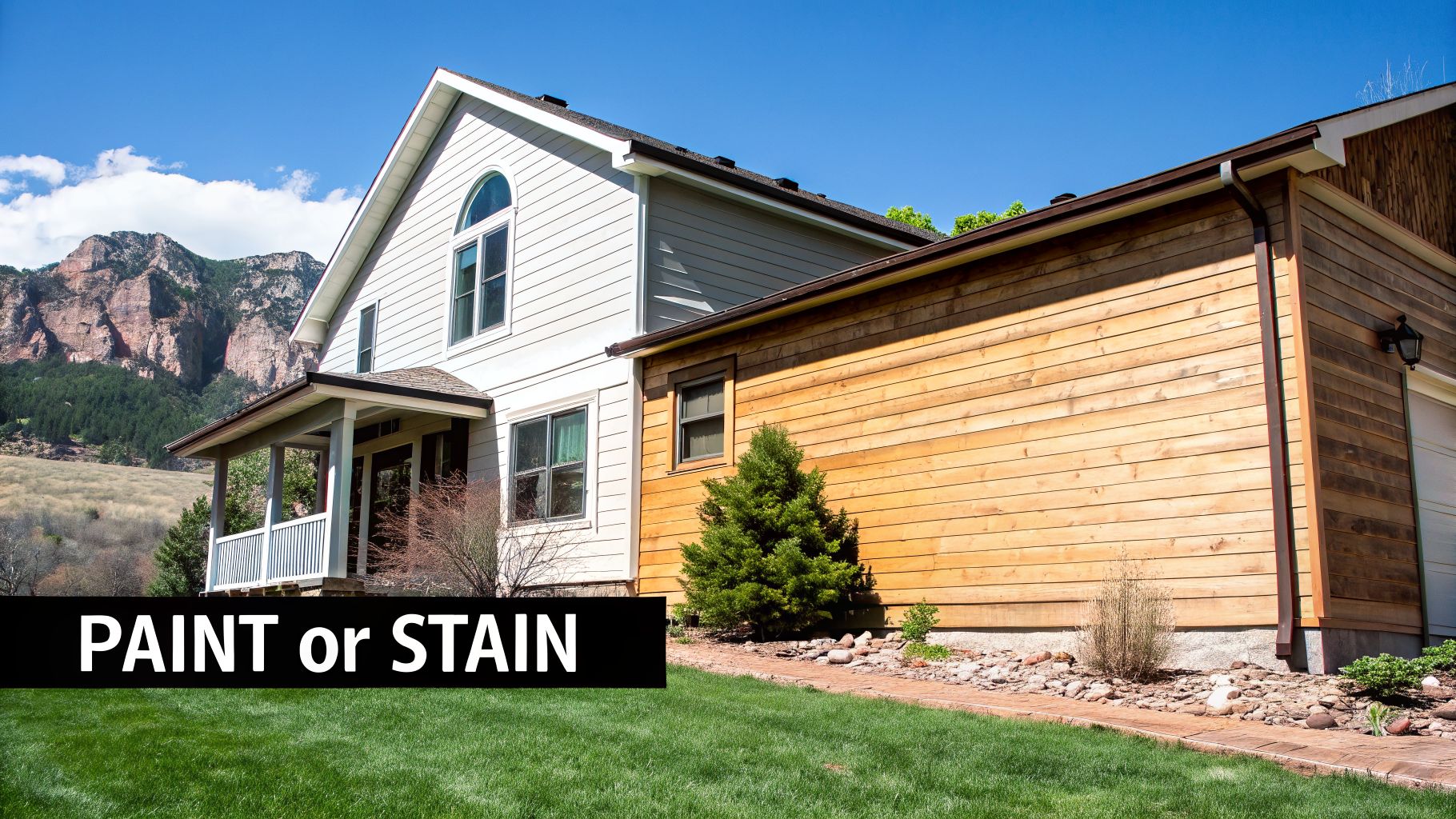
In Colorado, the conversation about whether to paint or stain the exterior of your home goes beyond color. Our harsh sun and crazy temperature changes require a coating that can really stand up.
Paint is your armor. It lies on top of the surface, creating a thick, protective film that offers incredible durability and endless color choices. So, it is an amazing choice for exterior siding. Stain, instead, penetrates wood deeply and blends perfectly with it. It emphasizes natural wood texture and provides that classic, rustic outdoor look of Colorado that everyone is fond of, thus it is wonderful for decks and fences where you desire to display the wood’s character.
Choosing Between Paint and Stain for Your Colorado Home
Choosing the right finish for your home is a very important step. In fact, it may be a decision time of more than just colors since you might be figuring out how your homes would stand the extreme snow, UV rays of the highest altitude, temperature changes from a cold freezing to a warm day that is typical of Colorado, all in a single day.
The difference is simple: paint covers, stain penetrates. Paint forms a barrier on wood, while stain soaks in. This affects everything, appearance and maintenance. This guide covers the key Colorado factors so you can choose the right materials for your house, deck, and fence.
Key Differences at a Glance
Before we get into the nitty-gritty, let’s start with a quick overview. This table breaks down the main differences to help you see which option might be the early frontrunner for your project.
Quick Comparison: Paint vs Stain for Colorado Climate
|
Attribute |
Paint |
Stain |
|
Surface Finish |
Forms an opaque film on top of the wood, hiding imperfections. |
Penetrates wood pores, enhancing natural grain and texture. |
|
Durability |
Offers superior protection against moisture and UV damage; lasts 5-10 years. |
More flexible and less prone to peeling; requires reapplication every 1-4 years. |
|
Aesthetic |
Provides unlimited solid color options for a uniform, modern look. |
Delivers a transparent to semi-solid finish for a natural, rustic appearance. |
|
Maintenance |
Requires extensive scraping and sanding to fix peeling or chipping before recoating. |
Simpler reapplication; typically just requires cleaning before a new coat. |
|
Best For |
Siding (wood, composite, fiber cement), trim, and covering of flawed surfaces. |
Decks, fences, and showcasing high-quality wood grain like cedar or redwood. |
Look closely, and it’s evident each has its pros and cons. Your decision will largely depend on the type of surface you intend to work with and the effect you desire to create.
Understanding the Core Choice
Imagine paint as a protective layer. It remains on the surface, making a significant, resistant coat which provides excellent defense against weather conditions. This way, it is a favorite for siding, particularly for fiber cement or composite, where the natural texture of wood is not meant to be the feature. Besides that, paint is a great helper for aging timber with a few imperfections; it hides them completely, giving a new, pure surface.
Stain is designed to be used on wood; the pigments penetrate wood fibers to a great depth, which allows the wood to expand and contract with changes in temperature. Actually, this is the stain feature that can make it perfect for outdoor decking, since it will withstand bubbling and peeling from foot traffic better.
Two alternatives are available for you: obtaining a solid color, which will provide the maximum and the longest level of protection, or accenting the wood’s natural charm with a less protective finish.
There isn’t a single perfect answer. Only the one that suits your particular project the most. If you’re interested in learning more, you can see our guide, which thoroughly explains the difference between stain and paint.
Understanding How Paint and Stain Actually Work
Understanding how each of these products works is very useful if you want to decide between painting and staining. It is not just a matter of having two different colors in a bottle; on the contrary, these are two totally different ways of protecting and finishing a surface. Actually, the way each product is made sets the whole scene, from the final appearance of the surface to the level of wear it can withstand and even the kind of maintenance you will have to do as time goes on.
Think of paint as a liquid protective cover for a surface. It has pigments for its color, binders that act like glue, and solvents that keep the paint in liquid form. When you use a brush or a roller to lay it on, the solvents evaporate, and a solid, colored layer remains on the surface. This forms a consistent and full coverage layer that not only masks the surface but also hides old wood grain, repairs, and other blemishes.
The Science of Stain Penetration
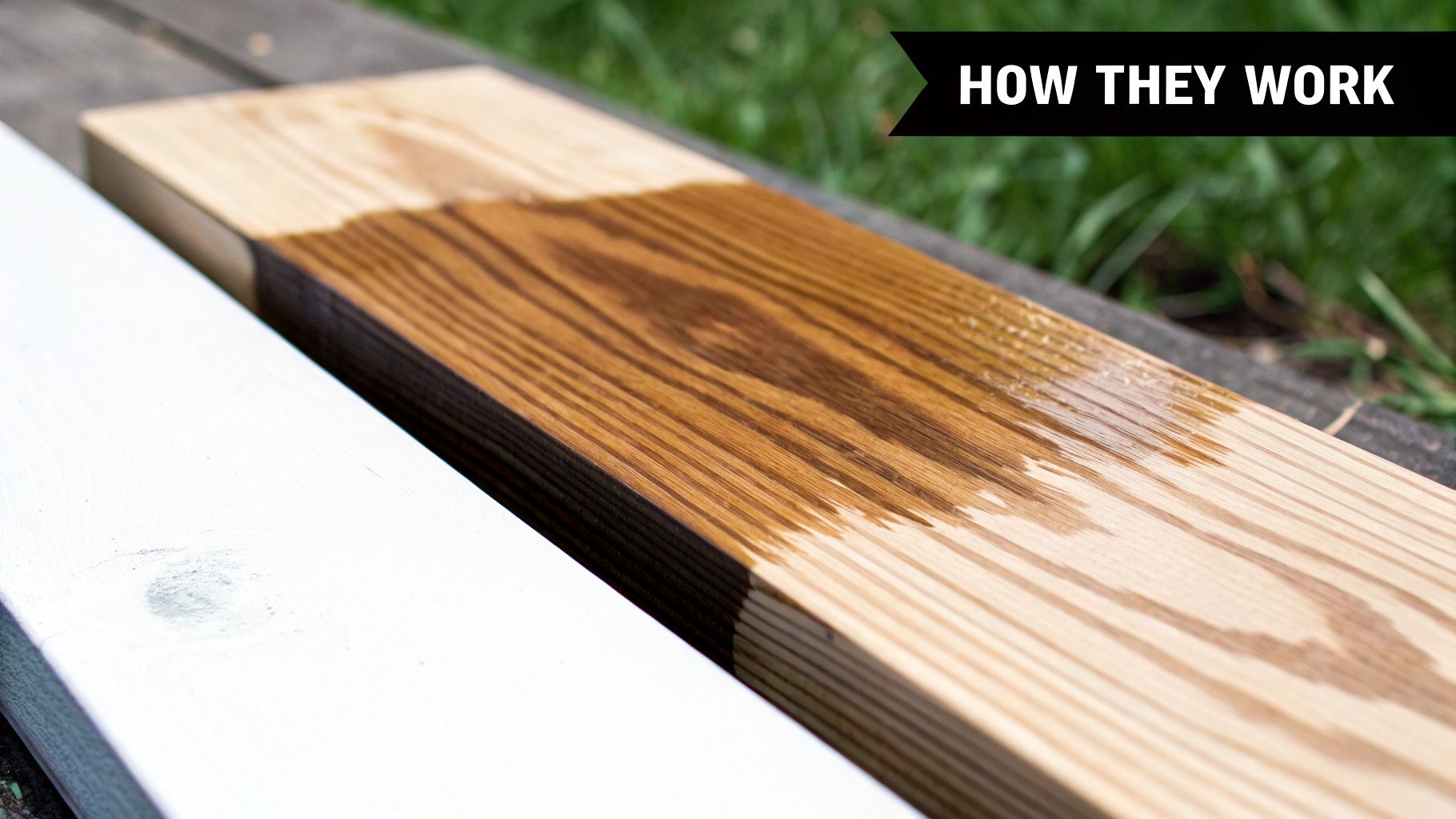
Stain works on a totally different principle. Instead of building a film on the surface, its tiny pigment particles are designed to penetrate deep into the wood’s pores. It doesn’t just sit on top; it becomes one with the wood itself.
Deep penetration like that is what makes stains not only reveal wood grain and texture, but also to highlight them naturally. Dyeing a cotton shirt works well as an analogy: one method discolors the fabric from within, the other just places the color on top.
Here is the most straightforward comparison: Paint creates a barrier on top of the surface, whereas stain is a defense that comes from inside. This one difference alone decides the failure or success of each paint finish in Colorado’s strong sun, snow, and unpredictable changes of temperature.
How Composition Impacts Performance
The binder, which is often an acrylic or an alkyd, forms that thick, protective shell. It is made to be hard and provides great protection from water and harmful UV rays. Because of this, it’s the preferred option for exterior walls where the main point is to make a barrier that the elements can’t get through.
Stain, on the other hand, depends on either oil or water-based binders that function more as carriers; they are responsible for dragging the pigment down into the wood fibers. As a matter of fact, a painting contractor told me that this way the wood can breathe, which is really essential.
Since wood is capable of expanding and contracting with the change of seasons, a stain finish being stretchable enough to move along with it is the reason that it is able to avoid the cracking and peeling that are usually seen on old paints. Such flexibility is a major plus/feature for decks and fences that are not only exposed to weather but also to the tread of people. Should you want to understand it deeply, consult our article on oil-based vs. water-based stains.
Protective coatings constitute the primary element in the maintenance of a property. In terms of the global market size of paints and coatings, it is estimated at about USD 211.28 billion and is going to continue to expand, which reflects the importance/influence of these products.
If you own a home in Westminster and the Denver metro area, remember that picking the right finishing is not only about obtaining a pretty facade; rather, it is tightly connected/linked with a very significant protective/securing measure of the value of your house. To find out more about these market trends, visit grandviewresearch.com.
Ultimately, your choice boils down to a trade-off between two different philosophies of protection.
- Paint: Provides maximum surface protection, unlimited color options, and the ability to hide imperfections.
- Stain: Offers deep-penetrating flexibility, highlights the natural beauty of wood, and is generally easier to recoat later.
Understanding this core difference makes the decision less about just picking a color and more about making a strategic choice for your home’s future. It’s about matching the right finish to the right surface for long-term success.
Comparing Durability and Maintenance in Colorado’s Climate
When trying to choose between paint and stain for your Colorado home, most often the deciding factor is simply which one is more durable. Our climate is quite harsh, and the very strong rays of the sun at high altitude, heavy snow, and extreme temperature swings throughout the day are capable of testing the endurance of any kind of exterior finish.
We explain how each one does and what is required to keep them looking good, in order to give you the piece of information essential for you to protect your investment.
Paint basically forms a protective shell. A good acrylic latex paint creates a thick, non-porous film over the wood, which is a fantastic barrier against moisture and UV rays. This is why it’s a popular choice for siding: it provides serious protection against water damage and prevents the sun from breaking down the wood fibers.
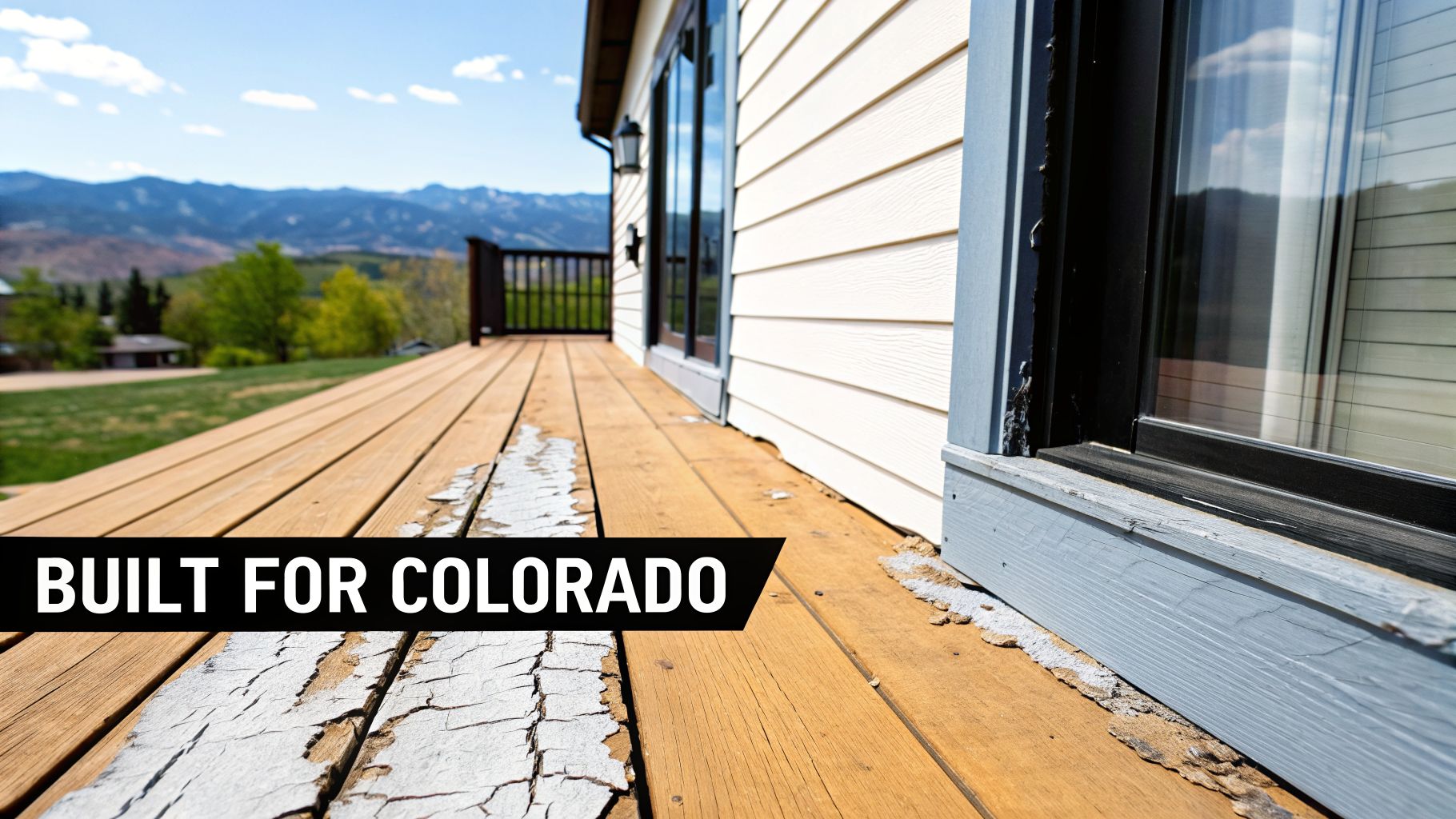
But that protective shell has a downside. As the wood expands and contracts with Colorado’s temperature swings, that rigid film can get brittle. Eventually, you’ll see the classic signs of paint failure: cracking, bubbling, and peeling.
The Paint Maintenance Cycle
Once paint starts to fail, the fix is a lot of work. You can’t just slap on another coat. To get a new coat of paint to actually stick and last, you have to do some serious prep.
The process usually looks something like this:
- Thorough Scraping: Every last bit of loose and peeling paint has to come off.
- Sanding: You have to sand the edges of the old paint to “feather” them out, creating a smooth transition.
- Priming: Any bare spots need a coat of primer to make sure the new paint bonds well and has an even finish.
This is the real headache of paint maintenance. If you cut corners on the prep, your new paint job will fail fast, and you’ll be stuck in a frustrating cycle of constant touch-ups. For a deeper dive on picking the right product for our intense sun, check out our guide on the best exterior paint for sun exposure.
The Stain Maintenance Advantage
Stain takes a totally different approach. Since it soaks into the wood instead of sitting on top, it won’t crack or peel. It moves and breathes with the wood as temperatures change, which makes it perfect for surfaces with a lot of movement, like deck boards and fence panels.
When a stained surface starts to look tired, the upkeep is much, much easier. There’s no peeling film to scrape off. Most of the time, a good power wash to remove dirt and grime is all you need before applying a fresh coat. This simple process is a huge plus, especially for homeowners who like to handle maintenance themselves.
Stain’s Achilles’ heel is mainly its low UV resistance. It contains less pigment and fewer binders compared to paint, so it is not capable of offering the same level of sun protection. This implies that, in order to keep the color and protection nice and fresh, you will have to apply it more frequently.
A Head-to-Head Maintenance Comparison
To really see the difference, let’s look at the typical maintenance schedule for a wood deck here in Colorado.
|
Feature |
Painted Deck |
Stained Deck |
|
Lifespan |
5-8 years before major failure, but will need touch-ups sooner. |
1-3 years for horizontal surfaces; 3-5 years for verticals. |
|
Failure Mode |
Cracks, blisters, and peels under foot traffic and weather. |
Fades and weathers as the finish is worn away by UV and moisture. |
|
Recoat Prep |
Intensive scraping, sanding, and spot-priming. A real project. |
Usually just needs a thorough cleaning or power wash. |
|
Long-Term Effort |
Less frequent, but far more labor-intensive maintenance. |
More frequent, but significantly easier and faster to reapply. |
Thinking about durability inside your home is just as important. For instance, understanding the most durable hardwood floor finish can offer great insights, as the principles of long-lasting finishes often apply across different projects.
In the end, the choice between paint and stain is a trade-off. Paint gives you a longer initial lifespan but demands a ton of effort when it’s time to recoat. Stain needs more frequent attention, but the maintenance is much simpler, so many homeowners find it more manageable over the long haul.
Finding the Right Look for Your Home
Deciding whether to paint or stain your home is a significant choice that will ultimately affect the whole picture of your home’s appearance. It is not only about selecting a color. It is about shaping the personality of the house as a whole. A home with a modern, clean look will have a different character than a rustic home that fits perfectly in the Colorado landscape, right?
Paint is the best option when you want to change the overall look completely. It allows you to get a very consistent and uniform appearance, not to mention that there is an almost unlimited range of colors to choose from.
So if the plan is to have a super bright and modern farmhouse, or, on the other hand, if you want to use a color of a very specific historical period, paint will give you an opaque and strong finish with which you can entirely change the exterior of your home.
This makes it a fantastic choice for giving an older home a facelift or for dealing with mismatched or imperfect wood surfaces. Paint lays down a protective film that essentially erases blemishes, leaving behind a crisp, polished look.
The Bold Statement of Paint
Paint doesn’t whisper; it makes a statement. A fresh coat in a striking color can instantly amp up your curb appeal and make your house the standout on the block. On the flip side, classic whites and soft grays can create a look of timeless elegance. As paint completely covers the wood, you’re in total control of the final look, regardless of the wood’s natural color or condition.
Here are a few scenarios where paint is the clear winner:
- Creating a Modern Look: Sharp whites, deep charcoals, or even a moody navy blue can give a home a distinctly contemporary feel.
- Restoring Historic Charm: Paint is ideal for matching historical color palettes, helping preserve the architectural soul of an older home.
- Hiding Imperfections: If your siding is older, weathered, or has seen a few mismatched repairs over the years, paint creates a flawless, uniform surface.
The Natural Appeal of Stain
Stain, however, takes a completely different approach. It’s all about working with the wood, not against it. Instead of sitting on top like a film, stain soaks into the wood fibers, highlighting the natural grain, texture, and character. It’s the perfect choice for anyone who wants to celebrate the organic beauty of their home.
Stain is the undisputed champion for creating a look that feels connected to our rugged Colorado surroundings. Options range from clear sealers that just deepen the wood’s natural tone to semi-solid stains that add a layer of color while still letting the grain peek through. It’s ideal for materials like cedar siding, log cabins, and heavy timber accents.
It really boils down to this: Do you want to redefine your home’s character with solid color, or do you want to enhance the natural beauty that’s already there? Your answer will almost always lead you straight to either paint or stain.
It’s also worth noting how the industry is changing. There’s a big push toward more environmentally friendly products, driven by homeowners who are more conscious of health and sustainability. People are actively seeking safer options with fewer harsh chemicals, which is driving manufacturers toward better water-based coatings. You can learn more about these sustainable coating trends and see how they’re shaping the industry.
At the end of the day, your choice in the paint-or-stain debate sets the tone for your entire property. Paint offers a blank slate for bold creativity, while stain honors and elevates the natural materials that give your home its unique spirit.
Which Finish Is Right for Your Specific Project?
The whole paint-versus-stain debate gets a lot less theoretical once you have a real-world project in front of you. The truth is, there’s no single “best” finish for your home. It’s really a series of decisions you make for each surface you tackle. Every area, from a high-traffic deck to vertical siding, has its own unique demands that usually make one option a clear winner.
Making the right call is all about context. A finish that performs beautifully on a low-contact surface like siding could fail spectacularly on a deck board you walk on every day. Let’s break down the most common projects we see here in Colorado to figure out which finish makes the most sense for each.
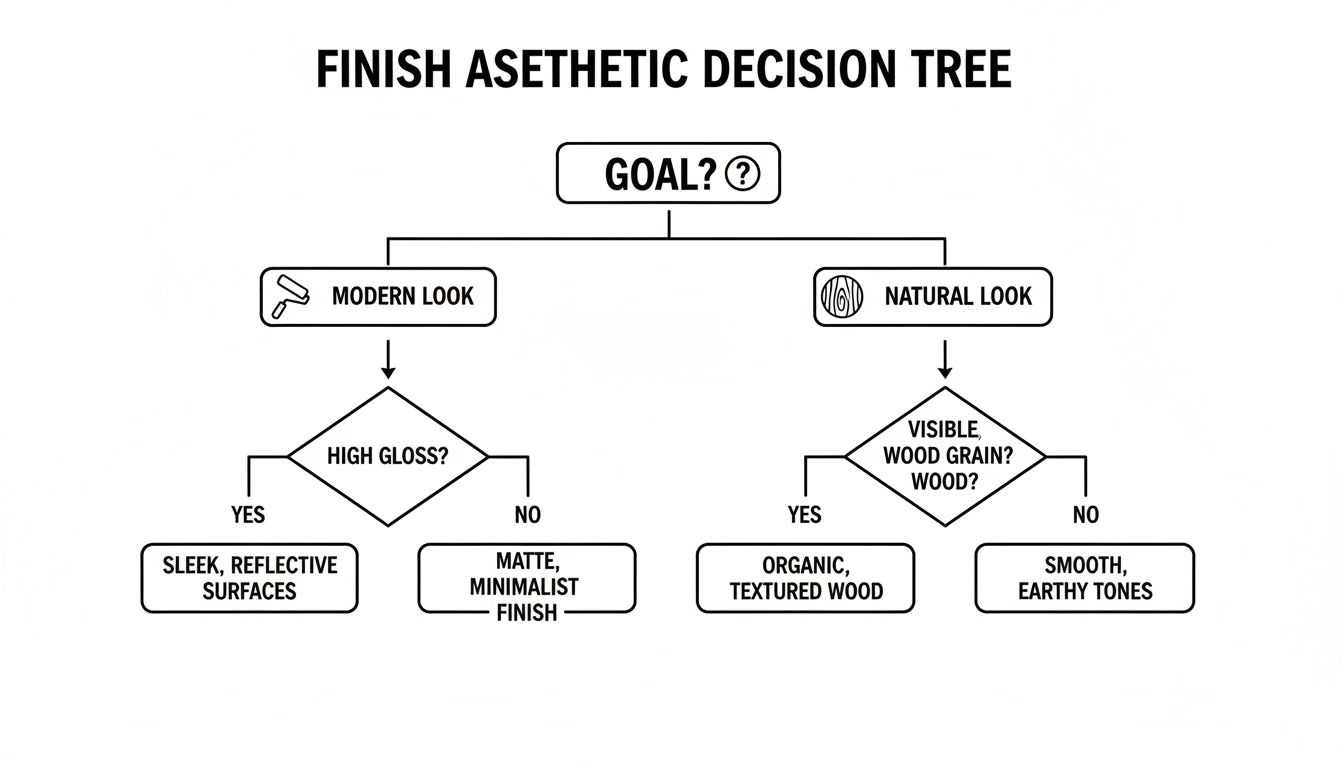
This decision tree can help you visualize whether you’re aiming for a clean, modern look or prefer a more natural, wood-grain-focused approach.
As the flowchart shows, the first question is always about aesthetics. If you want a solid, uniform color, paint is your path. If seeing that beautiful wood grain is the goal, you’re heading toward stain.
The Best Choice for Decks
When it comes to horizontal walking surfaces like decks, stain is the overwhelming favorite. I can’t stress this enough. The reasoning centers on durability under duress. Paint creates a thick film that just sits on top of the wood, which is fine for a wall, but a total disaster under foot traffic, scooting deck chairs, and Colorado’s relentless sun.
That paint film will eventually chip, crack, and peel. It is not a matter of if, but a matter of when. Then, you will be looking at a maintenance nightmare of several hours of scraping and sanding just to fix it. On the contrary, stain gets into the wood pores, so it will slowly lose its color rather than peel. Hence, generally, reapplication is a simple operation; in many cases, it is mainly a deep cleaning and then the laying of a fresh coat only.
Finishing Your Siding
When it comes to siding, paint generally gives you a longer life and better protection. This applies in particular to products like fiber-cement or composite siding, which have been made to be painted. A few layers of top-quality acrylic latex paint form a strong shield against moisture and UV rays and can easily last for ten years before it needs to be done again.
However, if you have stunning wooden siding such as cedar or redwood, then the decision might depend on your taste and preferences. Although paint protects you the most, it completely conceals that beautiful wood grain. In this situation, a top-grade solid or semi-solid stain can be an excellent middle ground, providing a durable, rustic appearance that highlights the wood’s natural character and at the same time protecting it effectively.
Fences: A Balanced Decision
Fences are where the paint-or-stain debate is a genuine toss-up. The right answer really comes down to your project’s personal priorities.
- Choose Paint If: You’re after bold, custom colors, want the absolute maximum weather protection, or need to perfectly match your home’s trim. Paint has a longer initial lifespan, but be prepared for more intensive prep work when it eventually starts to fail.
- Choose Stain If: Your main goal is easier long-term maintenance. A stained fence won’t peel, and recoating it every few years is a very straightforward process. Stain also gives the fence that classic, natural look that blends right into the landscape.
We’ve got a much deeper dive on this topic if you’re interested. You can explore our guide on fence stain vs paint to see what makes the most sense for your property.
Cabinets and Interior Trim
Inside the house, the choice generally depends on how things look. More often than not, people go for local cabinet painting companies when they want to change their kitchen’s style, as it is an affordable way to have a fresh and trendy appearance of the room overall. For example, we notice that the clients who want to change their lifestyle often repaint very yellow or red cabinets.
Staining really focuses on keeping that timeless, cozy appearance of the wood.
If your cabinetry is made from high-quality wood like cherry or walnut, staining your cabinets will be a way to bring out their natural beauty even more. A lot of times, the end result of being professional-looking is a matter of details; for example, choosing the right tip filters when working with fine enamel stains can greatly impact the overall exquisiteness of the finish.
In the end, the best finish is simply the one that suits your current project. Stain is top-notch for heavily used horizontal areas, paint offers a long-lasting protective layer for siding, and when it comes to fences and cabinets, the decision mostly boils down to the style you want and the amount of upkeep you’re prepared to do in the future.
Let’s Make the Right Call, With a Little Help
So, what’s the verdict? Paint or stain? By now, you’ve seen that the best choice really hinges on what you’re working with, the look you’re after, and how much upkeep you’re willing to handle down the road. It’s rarely a one-size-fits-all answer, especially here in Colorado. What works for your siding might be a disaster on your deck.
Getting the prep work right and choosing a product built for our climate isn’t just a good idea, it’s everything. An experienced painter could really save you from getting into a lot of trouble and spending unnecessary money. The skilled painter does more than simply put on a fresh coat. They examine your walls, notice issues at an early stage, and direct you to better materials that could withstand hot sun and cold, as well as wild temperature swings.
Why Talking to a Pro Makes All the Difference
It’s easy to get lost in the sea of options at the paint store. A professional consultation cuts through the noise and gives you a clear, strategic plan for your home.
Here’s what you should get out of a good expert assessment:
- Honest, Surface-Specific Advice: A real pro will walk your property, inspect the siding, trim, and fence, and explain why one finish makes more sense than another for each area.
- Inside Product Knowledge: They work with these materials every day. They know which products hold up and which ones fail a year later, especially in our local climate.
- A Solid Prep Plan: We always say that a great finish is 80% preparation. A contractor will map out every crucial step, from stripping old, failing paint to deep cleaning a sun-beaten deck.
A professional painter isn’t just selling a service; they’re offering a long-term strategy to protect your biggest investment. Their guidance ensures your final decision in the paint-or-stain debate is the right one for both beauty and durability.
Your Next Steps for a Finish That Lasts
Ready to get this project rolling with confidence? The smartest first move is a free, no-obligation estimate. It’s your chance to have a real conversation about your goals, get a handle on the costs, and see a clear plan for bringing your vision to life.
Home improvement is a huge part of our economy for a reason. With the U.S. paints and coatings market valued at an estimated USD 33.65 billion, it’s clear homeowners are investing heavily in their properties. You can read more about the paints and coatings market trends on mordorintelligence.com. This just underscores how important it is to make smart choices that protect that investment.
The easiest way to guarantee your money is wisely invested is by collaborating with a team you can really trust. Should you be in Westminster or anywhere around Denver, it’s super easy to get started. Just contact a local painting company near you, and together let’s discuss what your home requires.
Common Questions About Painting vs. Staining
When you’re looking at a finished surface, deciding between paint and stain can feel tricky. A few common questions always pop up, and getting the right answers is key to avoiding a project nightmare and ensuring the final result looks great for years to come. Let’s dig into the practical issues we see homeowners run into all the time.
Can You Paint Over Stain?
This is probably the most frequent question we get. The short answer is yes, you absolutely can. But, and this is a big but, you have to prepare it correctly. Since stain soaks into the wood rather than sitting on its surface, it leaves a surface that paint can bond to, as long as you give it a little help.
First, the surface needs a thorough cleaning to remove any built-up dirt and grime. After that, a light sanding is in order to rough up the old finish just enough for the new coat to grab onto. The most important step, though, is using a high-quality bonding primer. This creates a solid foundation for your paint, preventing it from peeling down the road and ensuring the color looks uniform.
What About Staining Over Paint?
Now, flipping the script is a completely different ballgame. Can you stain over paint? The answer to that is a hard no. Paint forms a solid film on the wood, effectively sealing it off.
To work properly, stain needs to seep into the wood grain; however, paint forming a barrier prevents it from doing so. So, if you decide to use stain after painting, then it would be necessary to remove all the old paint residue completely first. It is a massive undertaking that usually involves the usage of chemical strippers, heat guns, plenty of sanding, etc. Actually, it is significantly more time-consuming than simply painting on top of an old stain.
Here’s the bottom line: Paint can go over stain with the right prep, but stain can’t go over paint. You must completely strip the old paint before you can even think about applying stain.
Which One Costs More?
Cost is always a major factor. So, what’s more expensive, paint or stain? Looking at just the price per gallon, a high-quality exterior painting nearby and a premium stain are often in the same ballpark. The real difference in total cost comes down to labor and maintenance costs over time.
Painting can have a higher initial cost, especially if there’s a lot of scraping and sanding required to prepare the surface. Staining, on the other hand, is usually quicker to apply the first time around. However, it needs to be reapplied more often, especially on a deck exposed to Colorado’s weather, which can drive up the long-term cost over the life of the surface.
Ready to get a clear answer for your specific project? The expert painters nearby at I PAINT STUFF can assess your surfaces and provide a fast, free, and honest estimate to help you make the best decision for your home. Get your free estimate today.
